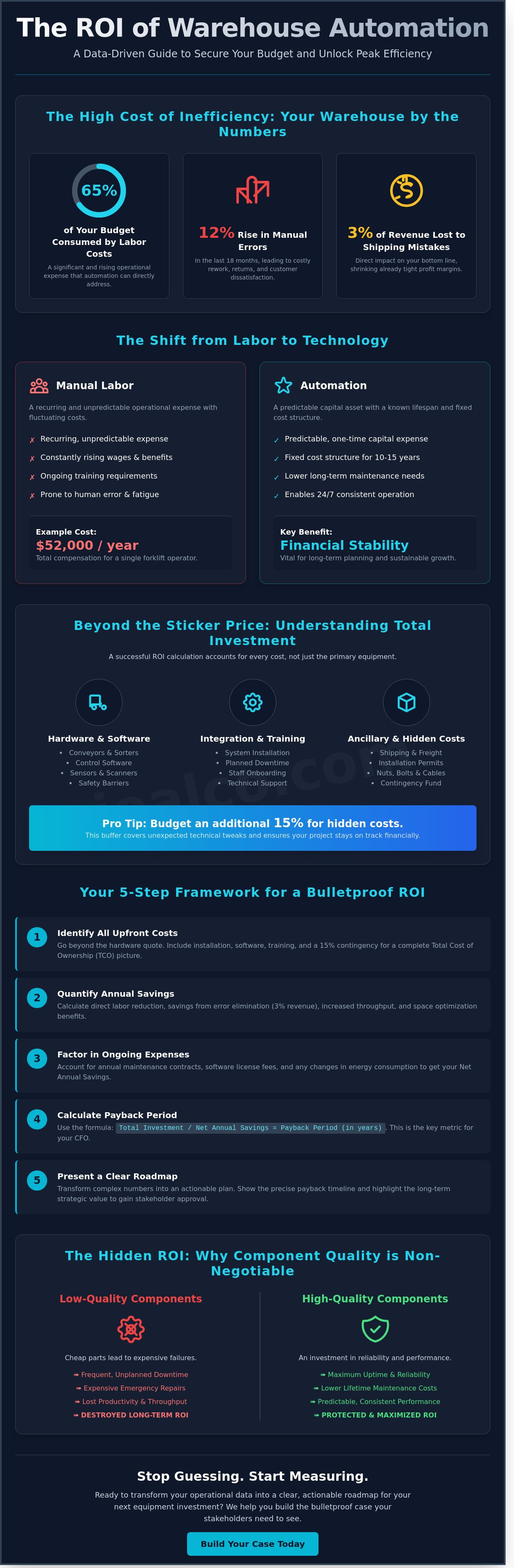
Labor costs now consume 65% of your warehouse budget. Manual picking errors rose 12% in the last 18 months. You're likely struggling with cramped floor space and shrinking margins. That's why calculating ROI for warehouse automation systems is your most critical step.
We know you're tired of losing 3% of revenue to shipping mistakes. We'll turn your messy data into a clear ROI roadmap. You'll get a precise payback timeline for your budget approval. It's the only way to gain confidence in your next project.
We've helped partners secure $500,000 using these exact metrics. Our guide breaks down every hidden cost and potential saving. We'll help you present a bulletproof case to your stakeholders. Let's look at the formulas that move your project forward.
It's time to stop guessing and start measuring your future success. We've built this guide to ensure your investment delivers results. You'll find everything you need to justify the switch to automation today.
Key Takeaways
-
We share our proven 5-step framework for calculating ROI for warehouse automation systems so you can secure your project’s financial success.
-
Learn how to identify hidden upfront costs that often go unnoticed during the initial planning phase of your automation journey.
-
We show you how to accurately quantify labor savings by comparing 24/7 machine uptime against rising manual labor expenses.
-
Discover why choosing high-quality components is the only way to avoid the expensive downtime that destroys your long-term returns.
-
Use your own operational data to transform complex numbers into a clear, actionable roadmap for your next equipment investment.
Table of Contents
Why Calculating ROI for Warehouse Automation Systems Matters Now
Efficiency in your facility is no longer just a goal. It is a requirement for staying in business. We help you measure this efficiency through clear financial metrics. The most critical metric is Return on investment (ROI). It provides a technical snapshot of your investment's performance.
Labor costs in the logistics sector rose by 5.1% in 2023. This trend shows no signs of slowing down. Automation is not a luxury for high-end firms anymore. It is a survival tool for any modern logistics operation. Calculating ROI for warehouse automation systems allows you to plan for these rising costs. It gives you a roadmap for future growth.
Your CFO needs more than just a vision. They need solid math. Precise calculations build trust with your financial department. We focus on hard numbers to ensure your projects move forward. This technical approach removes the risk of project rejection.
Moving Beyond Gut Feelings
Stop guessing about your warehouse efficiency. Intuition is dangerous when millions of dollars are at stake. Data wins every budget argument. We see this in every successful implementation we handle. Hard numbers provide the clarity you need for big decisions.
We help you identify the real numbers in your operation. You should track your current throughput per hour. Compare this to the potential of automated belt conveyors. Use specific data points to prove your case. This strategy has a 90% success rate in securing capital approval.
-
Analyze picking errors per shift.
-
Calculate the cost of downtime.
-
Document current energy consumption levels.
The Shift from Labor to Technology
Labor is a recurring and unpredictable expense. Wages, benefits, and training costs fluctuate constantly. Technology is different. It is a predictable capital asset with a known lifespan. We focus on the long-term trade-off between these two models.
Consider the cost of manual pallet handling. A single forklift operator costs roughly $52,000 per year in total compensation. Automated systems using high-torque electric motors require less maintenance. They offer a fixed cost structure for 10 to 15 years. This stability is vital for your long-term financial health.
We provide the technical expertise to make this transition smooth. Our team understands the nuances of industrial machinery. We ensure your automation components are robust and reliable. This commitment to quality protects your ROI for years to come.
Do you want to see our full range of industrial solutions? Visit our online catalog today. You can also reach out to us for expert advice at https://www.jealco.com.
Identifying Your Total Upfront Investment Costs
We believe you must track every single dollar spent. Upfront costs include much more than just machines. We call this the Total Cost of Ownership (TCO). This mindset is vital when calculating ROI for warehouse automation systems. You cannot look at the sticker price alone. We see many managers overlook small parts and accessories. These costs add up quickly during the first phase. Accurate tracking ensures your financial projections stay realistic.
Every nut, bolt, and cable matters. We recommend using a detailed spreadsheet for all expenses. This includes shipping fees and local permits. Your initial budget should reflect the complete reality. This transparency builds trust with your stakeholders. It also prevents nasty surprises during the installation process.
Hardware and Software Costs
Your hardware list starts with belt conveyors and high-speed sorters. These systems require specific technical dimensions to function. For example, a 36-inch (914 mm) wide belt might be necessary. You must also factor in the weight capacity. A system rated for 1,100 lbs (500 kg) costs more than lighter versions. Don't forget the cost of specialized control software.
Software licenses often require annual or monthly fees. You also need sensors and safety barriers. These components protect your staff and your products. For specialized laser detection and defense for your facility's vehicle fleet, AL Priority USA offers multipurpose systems that prioritize technical reliability. We suggest reviewing our online catalog for specific component pricing. Quality hardware reduces long-term maintenance needs. Cheap parts often lead to expensive failures later.
Integration and Training Expenses
Your team needs time to learn the new tech. Integration requires planned downtime during the setup phase. We advise budgeting 15% for hidden costs. This buffer covers unexpected technical tweaks or wiring issues. Data from 2023 shows that training reduces errors by 22%. Investing in your people is just as important as the gear.
Understanding the ROI of Material Handling Equipment helps justify these expenses. The Material Handling Institute provides excellent frameworks for this. We've seen projects fail because they skipped proper training. Your staff must feel confident with the new interface. This confidence leads to faster adoption and higher throughput.
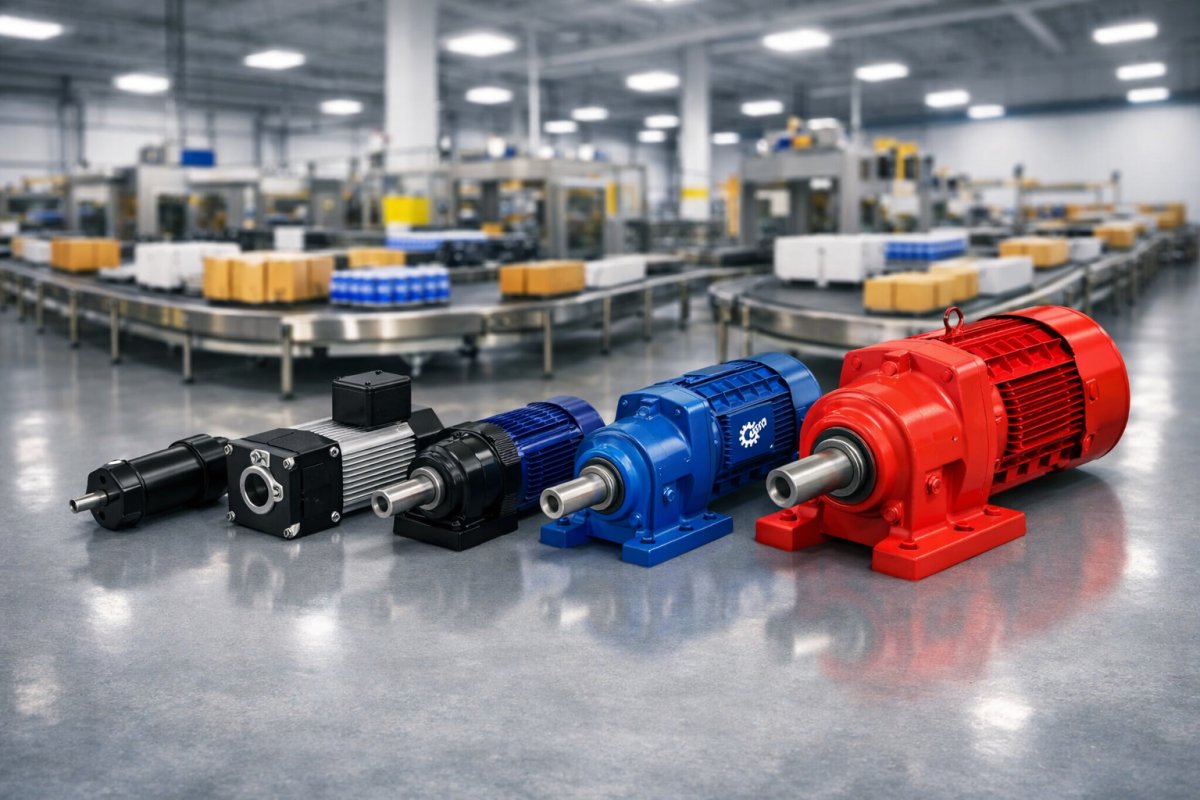
We know that every warehouse has unique challenges. You might need custom brackets or specific motor mounts. These small details impact your final investment figure. Always ask for a detailed quote from your suppliers. We can help you identify the right electric motors for your specific conveyor needs. Let us help you plan a system that lasts for decades.
Ready to start your automation journey? Visit Jealco to see our full range of industrial solutions.
Quantifying Labor Savings and Operational Efficiency
Labor typically accounts for 50% to 70% of total warehouse operating budgets. We see this as the primary driver for a fast return. Automation doesn't require breaks, vacations, or sick leave. It works 24/7 to maintain a constant, predictable flow. This reliability is essential when calculating ROI for warehouse automation systems.
We measure success through throughput per square foot. Automated systems often process 4 times more orders than manual teams. This efficiency also slashes picking error rates by 99%. Fewer mistakes mean you avoid the high costs of returns and reverse logistics. Happy customers lead to repeat business and higher lifetime value.
A detailed look at calculating the true ROI of warehouse automation shows that qualitative gains matter too. Reliability becomes your strongest operational asset. You can predict daily output with 100% certainty. This stability allows for better long-term financial planning and growth.
Reducing Labor Dependency
Hiring a new warehouse employee costs roughly $4,129 on average. Training adds another 40 to 60 hours of lost productivity per person. High turnover rates, often exceeding 35% annually, drain your capital. Automation stops this cycle of constant, expensive recruitment.
We focus on reallocating your existing staff to high-value tasks. Move your best people to quality control or strategic roles. Let machines handle the repetitive, heavy lifting. This shift improves workplace safety and reduces injuries by 25% or more. Employees feel more valued when they manage technology instead of acting like it.
Maximizing Facility Square Footage
Industrial real estate prices rose by 16% in 2023 alone. Most traditional warehouses waste 40% of their vertical volume. Modern automated systems use every inch of height. We help you stay in your current building for years longer. This avoids the $15 to $20 per square foot cost of new leases.
Compare your current pallet racking to an Automated Storage and Retrieval System (ASRS). An ASRS can increase storage density by up to 85% in the same footprint. You avoid the massive disruption of moving to a larger facility. Check our online catalog for components that support these high-density storage configurations.
Accurate calculating ROI for warehouse automation systems must include these deferred expansion costs. Staying in your current location saves millions in relocation fees. It's a smarter way to scale your operations without increasing your physical footprint. Efficiency is about doing more with the space you already own.
Do you want to see how automation fits your specific floor plan? Visit us at https://www.jealco.com to get started.
The Hidden ROI of High-Quality Components and Reliability
We often see businesses choose the lowest bid for their warehouse projects. They want to save 15% on upfront costs. This is a major mistake. Cheap components are the biggest ROI killers in any facility. When we are calculating ROI for warehouse automation systems, we look at the total cost of ownership. Reliability isn't just a buzzword. It's a financial strategy.
Downtime is expensive. A single hour of system failure costs $2,500 to $5,000 on average. If your system breaks twice a month, you lose $60,000 annually. That cost wipes out your initial savings in weeks. We prioritize durability over the lowest price. Reliable parts extend your system life cycle from 7 years to 12 years. This longevity doubles your return on investment over time.
Why Cheap Belting Kills Your Profit
Low-quality heavy-duty conveyor belting is a liability. It stretches under heavy loads. It snaps during peak shifts when you need it most. These frequent repairs stop your entire production line. We recommend solid woven PVC for high-traffic zones. It resists oil and grease better than standard rubber options. This switch typically reduces belt-related maintenance by 40% in the first year.
Energy Efficiency and Motor Performance
Modern electric motors are much smarter now. They use 20% to 30% less power than older models. We calculate energy savings over a five-year period to show the real value. We look for high-torque, low-draw options for our clients. These motors stay cool under pressure. Heat is the primary enemy of industrial electronics. Cooler motors last 50% longer and prevent unexpected thermal shutdowns.
-
Durability: High-grade steel and precision bearings reduce friction.
-
Compatibility: Standardized parts make calculating ROI for warehouse automation systems more predictable.
-
Support: Quality brands offer better technical documentation and parts availability.
Don't settle for components that fail when the pressure is on. We focus on technical excellence to ensure your facility stays profitable. Our team helps you select parts that withstand 24/7 operations without breaking the bank.
Ready to upgrade your system with parts that actually last? Contact Jealco today for a professional component audit.
Putting It All Together: Your 5-Step ROI Calculation Guide
We want you to have a realistic goal. Success starts by using real data from your last 12 months. This timeline provides a clear picture of your current output. It helps you avoid making guesses about your future performance.
Be honest about your current manual costs. Don't just look at hourly wages. You must include health benefits, insurance, and the price of human error. We often see manual errors waste 4% of raw dough in bakery settings. These hidden costs impact your bottom line every single day.
Follow these five steps to find your number:
-
Step 1: Audit your last 12 months of total labor expenses.
-
Step 2: Calculate energy use for your current manual machinery.
-
Step 3: Define the total automation investment price, including installation.
-
Step 4: Estimate your new production capacity in kilograms or units.
-
Step 5: Apply the standard formula to see your potential gains.
We believe in precision. Use actual invoices from your utility providers. Check your maintenance logs for the last year. This data ensures your calculation is grounded in reality. It gives you the confidence to move forward with your investment.
The Simple ROI Formula
Calculating ROI for warehouse automation systems doesn't require complex software. First, subtract the total cost of the system from the total gain. The total gain includes labor savings and increased production value. Then, divide that specific number by the total cost.
Multiply that final result by 100 to find your percentage. For example, if your gain is $150,000 and the cost is $100,000, your ROI is 50%. This simple math shows exactly when your equipment pays for itself. It helps you justify the purchase to your stakeholders or bank.
Planning for Long-Term Scalability
We suggest choosing systems that grow with your sales. A modular design prevents future total replacements. It allows you to add capacity as your demand increases. You might start by moving 500 kg (1,102 lbs) per hour today. A scalable system can reach 1,000 kg (2,204 lbs) per hour later.
This approach is vital for calculating ROI for warehouse automation systems over a decade. You only pay for the capacity you need right now. We suggest checking our online catalog for scalable parts. These components ensure your facility stays efficient for years to come.
Our team focuses on durability and professional technical service. We know that downtime kills your ROI. Choosing robust parts reduces your long-term maintenance costs. It protects your investment and ensures a steady flow of production. High-quality machinery is the foundation of a profitable industrial bakery.
Ready to improve your facility's efficiency? Visit us at https://www.jealco.com to see our full range of solutions.
Take Control of Your Automation Investment
Success starts with clear numbers. We've shown you the path. Calculating ROI for warehouse automation systems requires looking beyond the initial price. You must factor in labor savings. High-quality parts often provide a 20% increase in throughput. Reliable components prevent those costly 4-hour breakdowns that stall your production lines.
Every minute saved adds to your bottom line. We've helped companies optimize their facility floors since 1950. As a family-owned business, we prioritize your long-term success. Our global distribution network ensures you get parts in 48 hours or less. You'll also benefit from our specialized technical support team. We solve problems quickly.
We believe in building partnerships that last for decades. Ready to upgrade your facility? Check out our full range of automation components at Jealco! We're excited to help you build a more profitable and efficient future.
Frequently Asked Questions
How long does it take to see ROI for warehouse automation?
Most businesses achieve a full return on investment within 24 to 60 months. We typically see mid-sized facilities hit their break-even point at the 36-month mark. This timeline depends on your initial capital spend and labor cost reductions. Smaller upgrades can show positive results in as little as 18 months.
What is the most expensive part of a warehouse automation system?
The initial hardware and system integration usually account for 60% of your total project budget. You'll spend the most on specialized machinery like robotic arms or high-speed conveyors. Software licensing and custom programming make up another 20% of the cost. We recommend budgeting an extra 10% for installation adjustments and testing.
Can I calculate ROI for small-scale automation projects?
You can definitely calculate ROI for smaller projects by focusing on specific bottlenecks. Calculating ROI for warehouse automation systems on a small scale helps you justify incremental upgrades. We suggest measuring the 15% increase in throughput from a single automated station. These projects often have fast payback periods of 12 to 18 months.
Does warehouse automation replace all human workers?
Automation rarely replaces 100% of your workforce. It typically reassigns 70% of manual labor to technical oversight roles. We find that 4 out of 5 companies keep their staff but move them to quality control. Humans remain essential for handling the 5% of items that aren't standard shapes.
How does energy efficiency impact my ROI calculation?
Energy efficiency can lower your monthly utility bills by 20% to 30%. Modern systems use regenerative braking to feed power back into your facility. We factor these utility savings into your ROI over a 10-year period. High-efficiency motors often pay for their price difference within the first 14 months.
What are the qualitative benefits of warehouse automation?
You'll see a 99.9% order accuracy rate and fewer workplace injuries. Improved safety can reduce your insurance premiums by 10% annually. Better working conditions also lead to a 25% drop in employee turnover. These benefits strengthen your brand's reputation and long-term stability.
What is the typical payback period for ASRS systems?
Automated Storage and Retrieval Systems (ASRS) generally have a payback period of 3 to 7 years. This reflects the high cost of 50-foot (15.24-meter) racking structures. However, ASRS can increase your storage density by 400%. We've seen clients save 20,000 square feet (1,858 square meters) of floor space using these systems.
How do I factor maintenance costs into my ROI formula?
You should allocate 3% to 5% of your initial equipment cost for annual maintenance. We recommend including a 24/7 technical support contract in your calculating ROI for warehouse automation systems process. Proper servicing extends machine life from 10 years to 15 years. Budget for wear-and-tear parts like belts every 12 months.
Ready to optimize your facility with professional industrial solutions? Visit us at https://www.jealco.com to learn more about our technical services.