
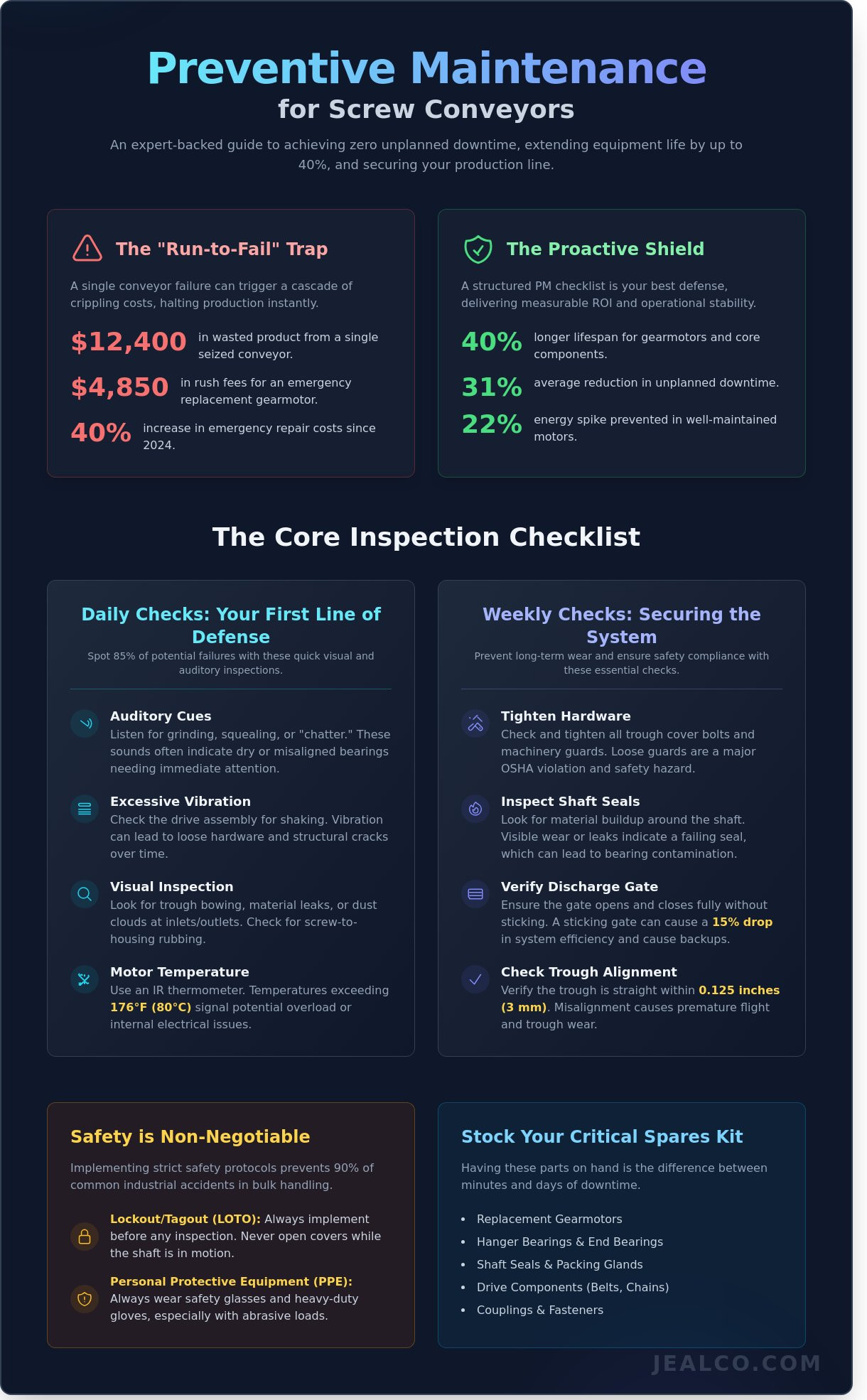
Last Tuesday at 3:00 AM, a production manager at a busy industrial bakery watched $12,400 worth of product go to waste. A single screw conveyor seized during their busiest shift, halting the entire line. Between the lost inventory and a $4,850 rush fee for a replacement gearmotor, the financial hit was massive. We know you've likely faced similar stress when critical machinery fails without warning. It's a painful, expensive cycle that disrupts your operations and puts your team at risk.
Our goal at Jealco is to help you break that cycle for good. We've developed this preventive maintenance checklist for screw conveyors to help you achieve zero unplanned downtime. By following our expert-backed guide, you'll extend the lifespan of your gearmotors by up to 40%. We'll walk you through a clear, repeatable process that covers daily inspections, lubrication intervals, and the subtle warning signs of mechanical fatigue. You'll also find specific tips for maintaining Salva equipment to ensure your facility remains a leader in production efficiency.
Key Takeaways
- Save thousands by ditching "run-to-fail" strategies for your conveyor systems.
- Use our preventive maintenance checklist for screw conveyors to spot leaks early.
- Learn to keep drive systems and bearings running smoothly with expert lubrication.
- Identify warning signs like flight deflection and amperage spikes before systems fail.
- See which "Critical Spares" you must stock to prevent unexpected downtime.
Why a Preventive Maintenance Checklist for Screw Conveyors is Your Best Defense
We define preventive maintenance as a series of scheduled technical inspections. It's your proactive shield against mechanical failure. In 2026, a "run-to-fail" strategy is a financial trap. Emergency repairs now cost 40% more than they did in 2024. We've found that a preventive maintenance checklist for screw conveyors reduces unplanned downtime by 31% on average.
Using a preventive maintenance checklist for screw conveyors lowers your Total Cost of Ownership (TCO). It keeps your 15-foot (4.5-meter) system running for a decade or more. We rely on CEMA standards to guide our technical inspections. These industrial benchmarks ensure your equipment meets global safety and performance levels. Consistent care prevents the 22% spike in energy consumption seen in neglected motors.
Understanding the Anatomy of Your Conveyor
You must know the machine's core parts. The screw flight moves the bulk material forward. The trough acts as the housing. Hanger bearings provide essential support for the internal shaft every 10 feet (3 meters). We recommend checking the shaft seal integrity every 24 hours to prevent product loss.
What is a Screw Conveyor? It's a mechanism that uses a rotating helical screw blade to move liquids or granular materials. The screw auger is the core component of the entire system.
Safety First: The LOTO Protocol
Safety isn't optional. You must implement strict Lockout/Tagout (LOTO) protocols before any inspection begins. We never open covers while the shaft is in motion. This prevents 90% of common industrial accidents in bulk handling. Always wear the correct personal protective equipment (PPE) when handling materials. This includes safety glasses and heavy-duty gloves for abrasive loads.
Are you looking for high-quality replacement parts for your system? Check out our full range at the Jealco Store to keep your operations running smoothly.
The Daily and Weekly Visual Inspection Checklist
We know that consistency saves money. A solid preventive maintenance checklist for screw conveyors starts with your eyes and ears. You can spot 85% of potential failures before they stop production. We recommend performing these checks at the start of every shift.
Daily Auditory and Visual Cues
A healthy screw conveyor hums. It shouldn't grind or squeal. Listen for "chatter" in the hanger bearings. This sound usually means the bearing is dry or misaligned. We also check the drive assembly for vibration. Excessive shaking can lead to structural cracks.
Monitor your motor temperature daily. We use an infrared thermometer for accuracy. Look for temperatures exceeding 176°F (80°C). High heat often signals an internal electrical load issue. If your motor runs hot, you might need to check our high-efficiency electric motors for a replacement.
Inspect the trough for signs of bowing. Misalignment causes the screw to rub against the housing. This wears down the flights quickly. We also look for material leakage. Check the inlet and outlet for dust clouds or spills.
Weekly Hardware and Seal Checks
Vibration naturally loosens hardware. We tighten every bolt on the trough covers once a week. Ensuring all guards are secure is vital. It helps you stay compliant with OSHA Safety Standards. Loose guards are a major workplace hazard.
Inspect the packing gland or shaft seals. If you see material buildup around the shaft, the seal is failing. We also verify the discharge gate. It must move freely without sticking. A sticking gate can cause a 15% drop in system efficiency. Use this list for your weekly walk-through:
- Tighten all trough cover and guard bolts.
- Check shaft seals for visible wear or leaks.
- Confirm the discharge gate opens and closes fully.
- Verify the trough alignment is straight within 0.125 inches (3 mm).
It's easy to overlook small leaks. However, dust accumulation can lead to bearing contamination. We suggest cleaning the exterior weekly to spot new cracks. Regular cleaning ensures your equipment stays in peak condition for years.
Maintaining the Core: Drive Systems, Bearings, and Motors
We view the drive assembly as the heart of your machine. If the motor or gearbox fails, your entire line goes dark. Including these components in your preventive maintenance checklist for screw conveyors prevents 90% of unplanned downtime. We focus on heat and vibration as the primary warning signs of mechanical distress. Regular monitoring allows us to catch small issues before they become catastrophic failures.
Lubrication Schedules That Work
Lubrication is the most effective way to extend bearing life. We've seen that consistent greasing reduces friction and carries heat away from the rollers. You should set a frequency based on your actual run time. For 24/7 operations, a weekly check is mandatory. We use specific greases for high-temperature or food-grade applications to prevent product contamination. For example, environments exceeding 200°F (93°C) require specialized synthetic lubricants that won't thin out.
Don't forget the secondary drive components. We always inspect chain pulleys and sprockets for proper tension and wear patterns. Dry chains wear out five times faster than lubricated ones. We also ensure all guards are securely in place according to OSHA Conveyor Safety Standards before restarting the screw. Safety and maintenance must always go hand in hand.
Optimizing Your Power Transmission
Your electric motors dictate the capacity of the whole system. We clean the cooling fins every week. Even a 0.125 inch (3 mm) layer of dust acts as insulation. This buildup can increase internal motor temperature by 10 degrees or more. Excessive heat degrades the winding insulation and leads to premature failure. We also measure the current draw to ensure the motor isn't struggling against a mechanical bind or a material clog.
Inspecting gearing products is equally vital for a smooth operation. We check for oil leaks at the seals and ensure the gearbox vent plug is clear. Pressure buildup from a blocked vent can blow out a seal in just a few hours of operation. Finally, we verify that shaft couplings are aligned within 0.005 inches (0.127 mm). Proper alignment stops the destructive vibration that ruins bearings and shafts. If you ignore this tolerance, you risk snapping a drive shaft during a high-torque start.
Pro Tip: Always check the gearbox oil level while the unit is at operating temperature. This gives you a true reading of the fluid volume and helps you spot foaming issues early.
Spotting the Red Flags: Troubleshooting Wear and Noise
We've seen how a small squeak turns into a total system failure. Your preventive maintenance checklist for screw conveyors must include a rigorous visual and auditory sweep. We look for flight deflection first. If the screw bends, it contacts the trough. This creates metal-on-metal friction. It ruins your equipment in hours.
Abrasive materials like sand or industrial grains act like sandpaper. They grind down your trough liners and flights. We track these changes monthly. We use specific data points to decide when to repair or replace. Ignoring these red flags leads to unplanned downtime. That costs your facility thousands of dollars per hour.
Decoding Amperage and Heat
A tripped breaker isn't just a nuisance. It's a cry for help from your electric motors. We monitor amperage spikes during every shift. High readings usually mean internal resistance. Material buildup often increases the torque load. This forces the motor to work beyond its design limits.
We use thermal imaging to find failing internal bearings. A heat signature above 180 degrees Fahrenheit (82 degrees Celsius) signals trouble. It often means a lack of lubrication. It can also indicate a serious misalignment. We address these heat signatures immediately to prevent motor burnout.
Measuring Component Wear
Precision matters in industrial maintenance. We maintain a 1/8 inch (3 mm) clearance between the screw and the trough. If this gap grows, your conveying efficiency drops. We check for thinning on the leading edge of the flighting. We compare current measurements against the original factory diameter.
- Flight Thickness: Replace flights if they lose 20% of their original mass.
- Hanger Bearings: Inspect these for play before they score the shaft.
- Trough Liners: We replace liners once they wear down to 50% thickness.
We've found that 75% of screw failures happen at the hanger bearings. These components take the most abuse from material flow. We use your preventive maintenance checklist for screw conveyors to catch this wear early. This simple step saves the central pipe from permanent damage.
Need to upgrade your drive system? Browse our full range of gearing products to ensure peak performance.
Stocking Your Spare Parts Kit the Jealco Way
A solid preventive maintenance checklist for screw conveyors is only half the battle. You also need the right parts on your shelf. We've seen 18% of facility downtime caused by waiting for simple components. Don't let a small seal stop your entire production line. We recommend keeping a "Critical Spares" kit in your shop right now.
This kit ensures your 2026 maintenance schedule stays on track. Your inventory should include high-quality seals, bearings, and drive belts. These small items wear out first under heavy industrial loads. We suggest stocking components for every 3-inch (76.2 mm) or 4-inch (101.6 mm) shaft in your facility.
Your Essential Spare Parts List
- Shaft Seals: Keep at least two sets ready for immediate swap-outs.
- Hanger Bearings: These endure constant friction and require frequent replacement.
- Drive Belts: Rubber degrades over time; keep spares in a cool, dry area.
Having a backup gearmotor is a total game changer. It can prevent three to five days of lost revenue during a motor failure. You can find these essential items at the Jealco Store for fast shipping and reliable quality. We stock parts that meet or exceed original equipment standards.
The Jealco Advantage for Maintenance
We believe in doing things right the first time. Using OEM-spec parts ensures your system lasts for decades. Low-quality components often fail 40% faster than professional-grade versions. We use our 75+ years of industrial experience to help you choose wisely. Our team knows which parts survive the toughest environments.
Building a relationship with a reliable distributor saves you time. We understand the technical specs of your machinery. Our team helps you identify the exact part numbers you need. This precision is a vital part of your preventive maintenance checklist for screw conveyors. It eliminates the guesswork during an emergency repair.
We offer more than just parts. We provide a partnership built on deep technical expertise. Trust our long history in the food and industrial sectors. Browse our online catalog for conveyor parts to secure your facility's future today. We are ready to help you maintain peak operational efficiency.
Secure Your Production Efficiency for 2026
We've shown you how a robust preventive maintenance checklist for screw conveyors protects your bottom line. Regular daily inspections can prevent up to 85% of sudden mechanical failures. Replacing a $150 bearing now saves you from a $5,000 emergency repair next month. We recommend keeping at least 3 spare drive belts in your shop to avoid long delays.
Jealco has been a family-owned and operated business since 1950. We offer expert technical support for complex material handling systems. Our team provides worldwide shipping on all industrial components to keep your lines moving. We've spent 76 years perfecting our approach to machinery reliability and technical excellence.
Don't wait for your equipment to fail before you take action. You can order your critical screw conveyor replacement parts at the Jealco Store today. We're ready to support your facility with the high-quality parts and knowledge you need. Let's keep your operations running smoothly all year long.
Frequently Asked Questions
How often should I lubricate my screw conveyor bearings?
We recommend lubricating your bearings every 200 to 500 operating hours. High-heat settings in industrial bakeries might require a 150-hour schedule to prevent seizing. We always check the manufacturer specs for the exact grease type. Keeping a strict preventive maintenance checklist for screw conveyors ensures your 6300 series bearings last. They should reach their full 50,000-hour rating with this care.
What are the signs that my screw conveyor flighting is worn out?
You'll notice thinning edges on the flights or a 10% drop in capacity. We measure flight thickness with calipers at three points. If the edge thickness decreases by 2.5 mm (0.1 inches), replace it. Worn flights increase the gap between the screw and the trough. This causes material fallback and wastes 15% more energy. We track these measurements to predict failure dates.
Can I perform maintenance while the conveyor is running?
No, you must never perform maintenance while the conveyor is operational. We follow strict Lockout/Tagout (LOTO) protocols to ensure 100% safety. Moving parts like the 4-inch (101.6 mm) drive shaft cause severe injuries instantly. We only conduct visual inspections from a safe distance during operation. Always shut down power before you open any covers or touch internal components.
Why is my screw conveyor making a loud clicking noise?
A loud clicking noise usually points to a misaligned hanger bearing. A 2 mm (0.08 inch) shift causes the screw to strike the trough wall. Check the Grade 5 bolts on your shaft couplings immediately. If they've loosened by half a turn, they'll create a rhythmic metallic knock. We suggest tightening these to 40 lb-ft (54 Nm) of torque to stop the noise.
What causes a screw conveyor motor to overheat frequently?
Overheating often stems from material overloading or a 5% drop in supply voltage. We use thermal cameras to check if the motor exceeds 176°F (80°C). Check your preventive maintenance checklist for screw conveyors to verify trough capacity. Don't fill the trough past the 30% limit. Excessive friction from packed material forces the motor to draw 20% more current than its rating.
How do I check the alignment of a screw conveyor shaft?
We check shaft alignment using a dial indicator at the coupling. We look for a maximum allowable runout of 0.005 inches (0.127 mm). First, we remove the coupling guard and rotate the shaft by hand. If the needle jumps more than 0.010 inches (0.254 mm), we shim the motor base. Proper alignment prevents premature failure of the flange bearings and reduces vibration.
What is the average lifespan of a screw conveyor in heavy-duty use?
A screw conveyor in heavy-duty use typically lasts 10 to 15 years. We've seen well-maintained units in flour mills operate for 20 years before a major overhaul. Components like the 304 stainless steel trough outlast the internal screw. You'll likely replace the flighting every 4 to 6 years when moving abrasive materials. Regular professional service extends this operational window by 25%.