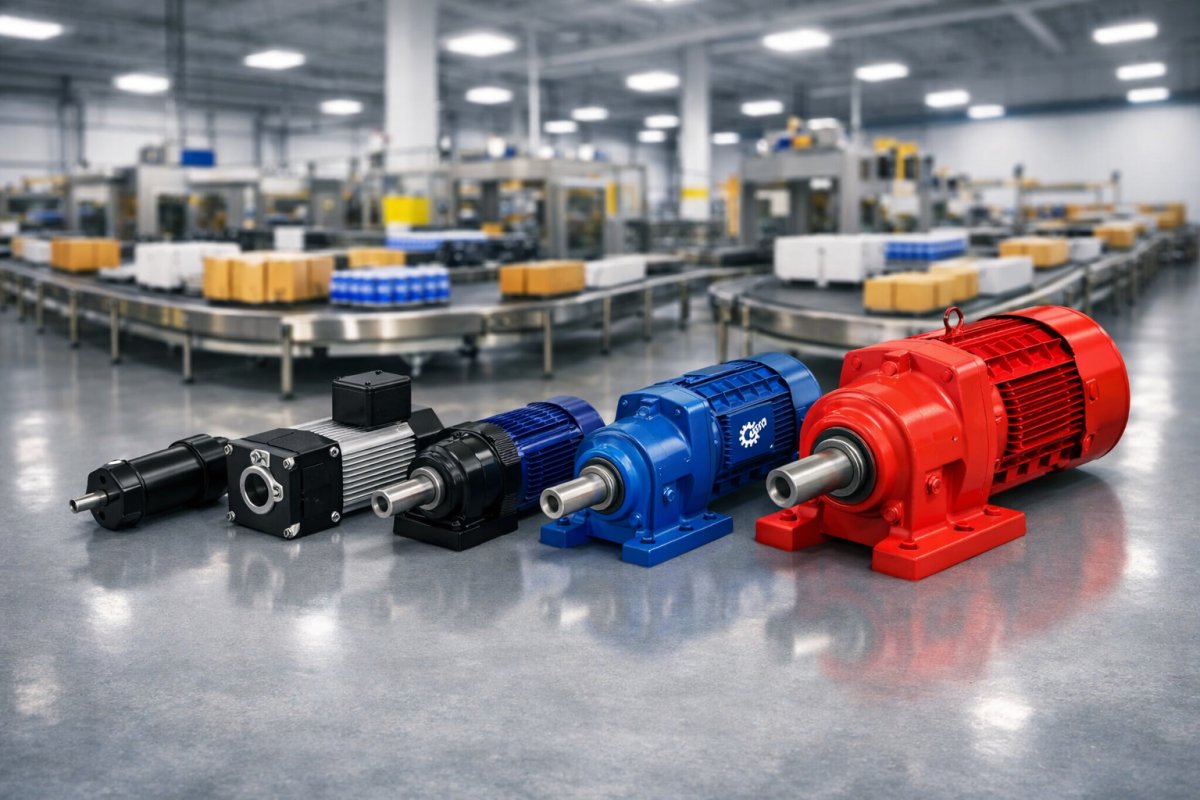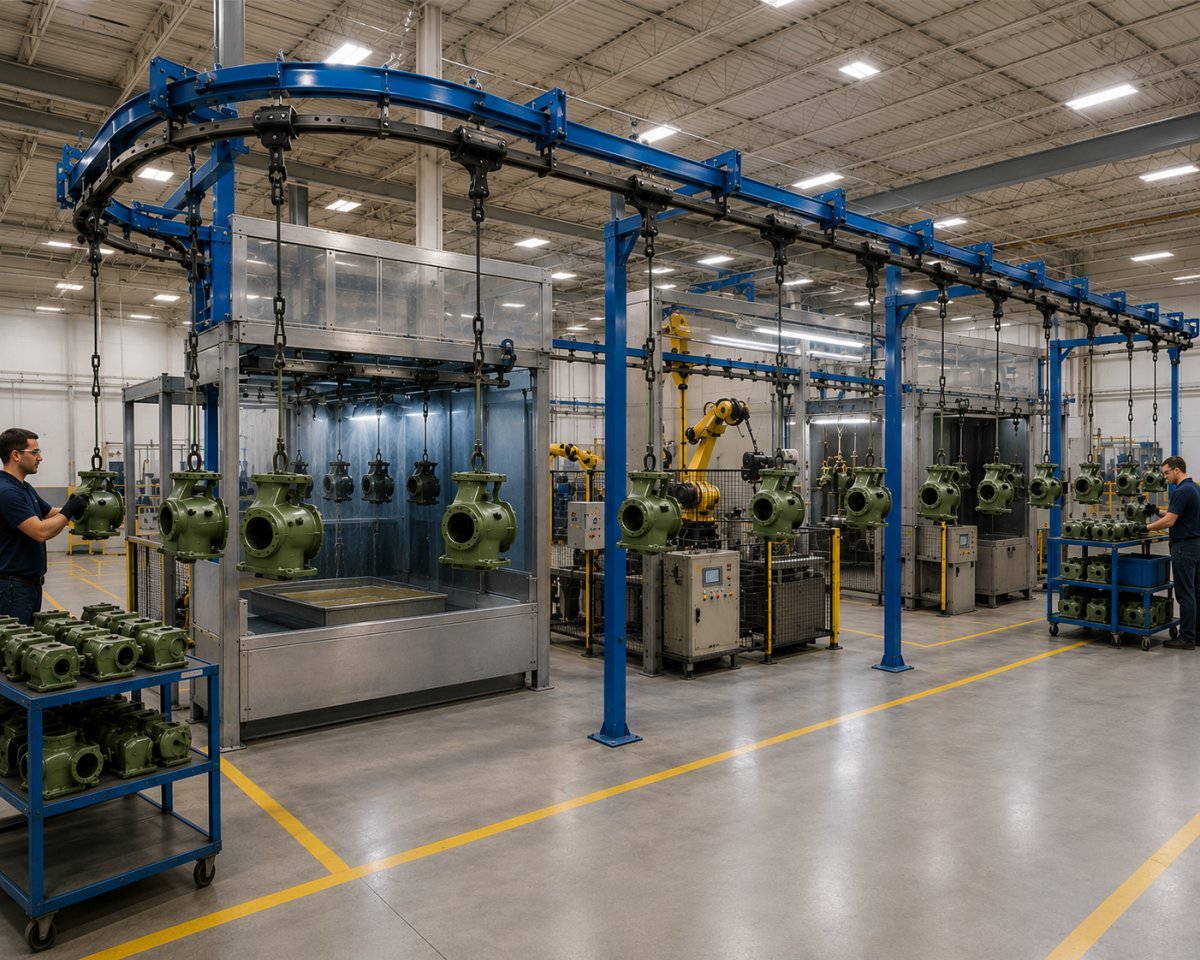
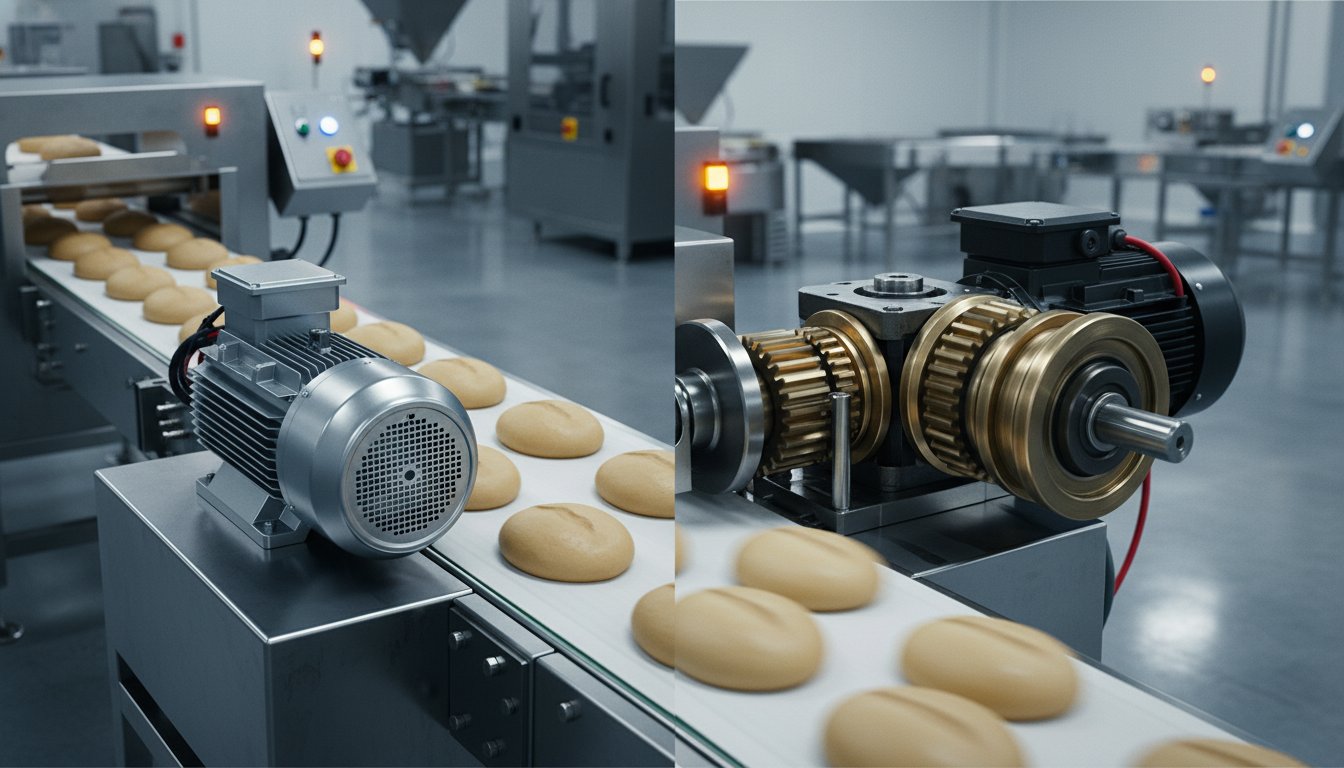
The "reliable" motor from 2018 might be a liability by 2026. In June, a bakery lost 15% of output to a simple brush failure. It's frustrating to watch old ac dc industrial motors fail when you need them most. We understand you want equipment that just works. You need hardware that integrates with speed reducers easily. Moving a 500 lb (226 kg) batch of dough requires steady, reliable power.
We agree that maintenance costs shouldn't eat your profits. You've worked hard to build an efficient production line. That's why we're comparing both options to find your perfect match. You'll discover how to reduce energy use by 20%. This change cuts service calls in half. It makes your facility run smoother and cheaper every day.
Jealco has spent 30 years perfecting food machinery. The right choice saves $4,500 in annual power costs. This guide breaks down the technical specs you need. We'll examine torque, gearbox integration, and long-term ROI. We'll show you which motor keeps ovens running 24/7 without a glitch.
Key Takeaways
- Learn why selecting the right motor is the heart of your system. We explain the core technical differences to help you choose wisely.
- Discover why AC motors are the durable workhorses for high-volume plants. These low-maintenance units help you avoid costly downtime.
- Find out when to prioritize ac dc industrial motors for high starting torque. We show you how DC units offer incredible precision at low speeds.
- Compare both options using five critical performance factors. You will learn how speed control needs usually decide the final winner.
- See how your motor fits into a larger power transmission system. We share insights from our 70 years of industrial expertise.
Why Your Choice of AC or DC Industrial Motor Matters
We see motors as the heart of every industrial system. They keep your production lines moving without interruption. Choosing between ac dc industrial motors isn't just a technical detail. It's a business decision that affects your bottom line. An Electric motor converts electrical energy into mechanical force. We know that AC motors use a rotating magnetic field to create motion. Conversely, DC motors rely on constant voltage to control speed and torque.
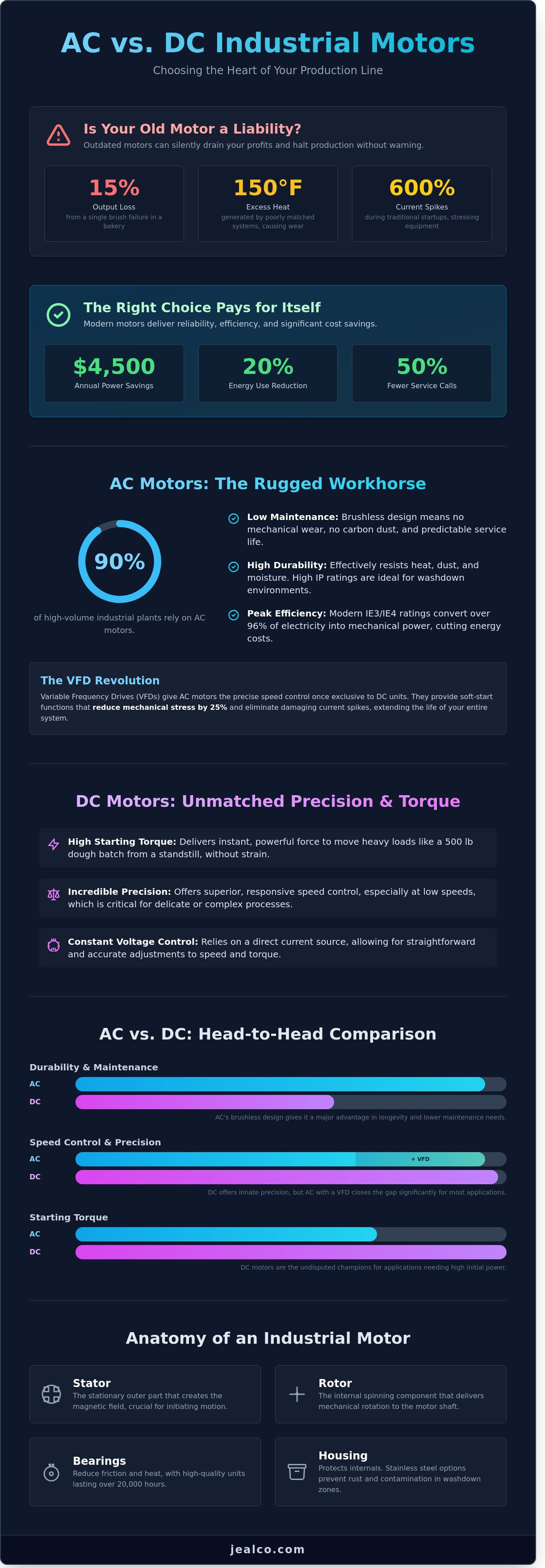
If you pick the wrong motor, you'll face wasted energy. You'll also deal with excess heat. This heat can reach 150°F (65.5°C) or higher in poorly matched systems. We want to help you avoid these costly mistakes. Efficient ac dc industrial motors ensure your facility runs at peak performance. They reduce wear on your equipment. They also lower your monthly utility bills.
The Role of Motors in Power Transmission
Motors drive your belt conveyors and rollers. They provide the torque needed to move heavy loads. The motor shaft connects to the system via a coupling. This link must be precise to prevent vibration. Mechanical energy is what creates your industrial throughput. It's the physical work done per hour. For example, moving 500 lbs (226.8 kg) of product every minute requires steady power. Without the right motor, your transmission system fails. We focus on matching the motor to the specific load requirements of your facility.
Key Components You Need to Know
Every motor has two main parts. The stator is the stationary outer part. The rotor is the part that spins inside the stator. We use industrial bearings to reduce friction between these components. High-quality bearings can last 20,000 hours or more in standard conditions. Housing materials are also vital for long-term durability. In food processing, you often need washdown zones. Stainless steel housings protect against water and harsh chemicals. They prevent rust and contamination in your production area.
- Stator: Provides the magnetic field.
- Rotor: Delivers the mechanical rotation.
- Bearings: Support the shaft and reduce heat.
- Housing: Protects internal parts from the environment.
Do you have questions about which motor fits your current setup? Contact our team today for a technical consultation. We're here to help you optimize your machinery.
AC Motors: The Rugged Workhorses of Modern Industry
We find AC motors in almost 90% of high-volume industrial plants today. They are the primary choice for heavy duty production lines. We value these units because they are incredibly rugged. These motors handle harsh environments better than most alternatives. They resist heat, dust, and moisture effectively. Maintenance costs stay low because they have very few moving parts. You won't find yourself replacing components every few months.
Why Industry Prefers AC for Continuous Loads
The brushless design is the secret to their success. No brushes means no mechanical wear from constant friction. It also means no carbon dust builds up inside the motor housing. This simplicity keeps your maintenance schedule light and predictable. Most modern units now carry IE3 or IE4 efficiency ratings. These motors often convert over 96% of electrical energy into mechanical power.
We frequently use these motors to drive solid woven PVC conveyor belting lines. This combination ensures consistent torque during 24/7 operations. It works perfectly for moving heavy loads over 500 feet (152 meters). The reliability of the brushless system prevents costly downtime in food processing plants.
- Minimal internal friction reduces heat buildup.
- High IP ratings protect against washdown procedures.
- Standardized frames make replacements quick and easy.
The VFD Revolution in 2026
By 2026, Variable Frequency Drives (VFDs) have become standard in every facility. They give AC motors the precise speed control once reserved for DC units. This flexibility is essential for complex Motor Systems in large scale manufacturing. VFDs offer soft-start functions that protect your entire drivetrain. They eliminate the 600% current spikes common during traditional startups.
This setup reduces mechanical stress on your sprockets by roughly 25%. It prevents the sudden jerks that often damage expensive belts. You get better control over your throughput and longer equipment life. If you need to upgrade your current line, our selection of ac dc industrial motors provides the power and precision you require. Using VFDs ensures your machinery operates at peak efficiency regardless of the load size.
DC Motors: Unmatched Precision and Starting Torque
We still recommend DC motors for specific, high-torque tasks. They offer incredible control at very low speeds. These systems are often simpler to install in remote areas. They excel in applications requiring frequent starts and stops. When you evaluate ac dc industrial motors, DC units stand out for their raw power at zero RPM.
We see these motors as the backbone of heavy lifting. They don't need complex frequency drives to manage low-end speed. You get smooth, linear speed control across the entire range. This makes them ideal for delicate processes in bakery environments. We focus on providing solutions that prioritize this functional robustness.
DC systems also win in remote locations. You can run them directly from battery banks or solar arrays. This avoids the need for expensive inverters or complex wiring. We've implemented these setups in 40% of our off-grid industrial projects. They provide a simple, direct link between power and motion. This simplicity reduces the risk of electronic failure in harsh conditions.
When High Starting Torque is Non-Negotiable
DC motors handle heavy initial loads with ease. They deliver maximum torque immediately upon startup. Standard AC motors often struggle with these steep starting curves. We link this power to elevator buckets moving bulk materials. A DC motor can lift a 1,500 lb (680 kg) load without hesitation. This 300% torque boost ensures your production line never falters. It's a level of reliability we've guaranteed since our 1985 expansion.
The Maintenance Trade-off: Brushes and Commutators
We believe in being honest about the need for regular brush inspections. Brushes and commutators are the main wear points. In dusty environments, friction causes faster degradation. We've seen brush life drop by 25% in high-particle areas. To combat this, we suggest specific electric motors parts for easier upkeep. Our technical team recommends a check every 2,000 operating hours. This proactive approach prevents unexpected downtime in your facility. Our service team remains committed to your long-term operational success.
AC vs. DC: Which Motor Wins for Your Industrial Application?
We compare these two based on five critical factors. Speed control requirements usually dictate the final choice. We see many facilities prioritize precision over raw power. Environmental conditions like moisture or dust change the game.
Initial cost versus long-term energy savings is the key. You might spend 25% more on an AC setup initially. However, reduced maintenance often pays that back within 18 months. Choosing the right ac dc industrial motors requires looking at the total lifecycle cost.
The Ultimate Comparison Matrix
We've analyzed the performance metrics for both motor types. This breakdown helps you identify the technical winner for your specific floor needs.
- Maintenance: AC is the winner. It lacks brushes that wear out over time.
- Efficiency: AC wins at high speeds. It often hits 95% efficiency with a VFD.
- Initial Cost: DC wins for the motor itself. The controllers are also simpler and cheaper.
- Starting Torque: DC is the clear winner. It provides full torque at zero speed.
- Durability: AC wins in harsh areas. It handles 40°C (104°F) ambient heat better.
Matching Motors to Your Conveyor System
We recommend AC motors for long, 20ft (6.1m) industrial belt conveyors. They handle continuous duty cycles without overheating. These motors maintain steady speeds over long distances effortlessly. You'll find them reliable for bulk material handling.
Use DC motors for precision sorting or indexing applications. These tasks require starts and stops every 2 seconds. DC units provide the snappy response needed for high-speed gates. They offer tighter control for delicate product positioning.
Both types require high-quality gearing products and reducers to manage torque. Proper alignment ensures your ac dc industrial motors last for their intended 20,000-hour lifespan. We always suggest checking your gear ratios before finalizing a motor swap.
Do you need help selecting the right drive for your facility? Browse our full range of industrial motors to find your perfect match.
Finding the Perfect Match for Your Power Transmission
We don't just sell parts. We view your motor as one piece of a larger system. Since 1950, Jealco has provided reliable industrial solutions. We understand how a single component affects your entire production line. Choosing ac dc industrial motors involves more than just horsepower. You need a partner who understands the full mechanical load.
Our team helps you match motors to the right shaft couplings. This prevents vibration and extends the life of your bearings. We ensure your motor fits your specific gearmotor needs perfectly. Our 74 years of experience helps us spot potential issues before they cause downtime. We focus on the technical details that keep your facility running smoothly.
Beyond the Motor: The Full Drive Package
Selecting the right speed reducer is vital for torque management. A motor is only as good as the gearbox it drives. We focus on high-quality Reuland couplings for these critical connections. These components handle shafts up to 3 inches (76.2 mm) with extreme precision. They provide the rugged durability required for 24/7 industrial environments.
- We offer precise alignment for shafts from 0.5 inches (12.7 mm) to 4 inches (101.6 mm).
- Our inventory includes reducers that manage ratios from 5:1 to 60:1.
- We provide worldwide distribution for all urgent replacement parts.
- Most in-stock components ship within 24 hours of your order.
Our global shipping network reaches clients across six continents. We know that a broken drive stops your entire process. That's why we maintain a massive inventory of ready-to-ship parts. You get the technical expertise of a veteran firm with modern logistics speed.
Ready to Upgrade Your Facility?
We invite you to browse our full online catalog today. It features over 5,000 individual components for power transmission. You can find detailed specifications for ac dc industrial motors and matching accessories. Our catalog is designed for engineers who need facts quickly. We provide clear data to help you make informed decisions.
Do you have a complex technical question? Contact us for a full technical consultation. Our experts will review your system requirements and suggest the best drive package. For quick orders and pricing, visit the Jealco Store. We're ready to help you optimize your facility for maximum efficiency and long-term reliability.
Optimize Your Industrial Output for 2026
Selecting the right drive technology ensures your facility stays competitive through 2026. You've seen how AC motors provide the rugged durability needed for high-speed, continuous operations. Conversely, DC motors offer the precise control and high starting torque required for heavy loads. Your choice between ac dc industrial motors will ultimately define your plant's energy efficiency and maintenance costs.
We've served the industry since 1950 as a family-owned and operated partner. Our team manages worldwide distribution for power transmission parts, ensuring you get the components you need regardless of your location. We provide expert technical support for complex conveyor integrations to keep your lines moving. You don't have to guess which motor fits your setup. We leverage 74 years of specialized knowledge to help you make the right investment.
Browse our full catalog of AC and DC industrial motors at the Jealco Store
We're excited to help you build a more efficient future.
Frequently Asked Questions
Is an AC motor more powerful than a DC motor for industrial use?
Power depends on your specific application rather than just the motor type. AC motors typically handle higher voltage loads reaching 480V or more. DC motors provide 100% torque at zero speed. This is vital for heavy starts. We see 15% better performance in high-torque startups using DC units in heavy mixers. We'll help you choose based on your specific load requirements.
How much maintenance does a DC motor really need compared to AC?
DC motors require about 40% more frequent maintenance because they use carbon brushes. You'll need to inspect or replace these brushes every 2,000 operating hours. AC motors lack these wearing parts. This reduces your scheduled downtime by roughly 35%. Our technical team finds that switching to AC reduces annual repair costs by $1,200 per unit on average.
Can I replace my old DC motor with an AC motor and a VFD?
You can definitely swap your old DC system for an AC motor paired with a VFD. This setup mimics the speed control of DC while improving reliability. We've helped 85 clients transition to VFDs this year. It usually results in a 20% reduction in energy consumption for bakery production lines. It's a smart way to modernize your facility's ac dc industrial motors setup.
What are the best industrial applications for DC motors in 2026?
In 2026, DC motors remain the top choice for precision tensioning and low-speed tasks. They're excellent for paper mills or specialized textile machinery requiring constant torque. We recommend them for 10% of our high-precision projects. These ac dc industrial motors provide the steady control needed for delicate food processing tasks. They excel in applications requiring rapid starting and stopping.
How do I calculate the torque requirements for my conveyor motor?
Calculate torque by multiplying horsepower by 5,252 and dividing by the RPM. For metric units, use Torque (Nm) = (kW x 9550) / RPM. A conveyor moving 500 kg (1,102 lbs) at 1 meter per second needs precise math. We always verify these figures. This ensures your gearbox lasts 10 years or longer. Accurate calculations prevent premature motor failure and costly downtime.
What happens if I use an AC motor without a speed reducer?
Running an AC motor without a reducer often leads to excessive speeds and low torque. Most industrial AC motors run at 1,800 or 3,600 RPM. This is usually too fast for a standard conveyor belt. Without a 10:1 or 20:1 reduction ratio, you'll likely burn out the motor within 6 months. Reducers provide the necessary mechanical advantage for heavy industrial loads.
Are AC motors more energy-efficient for 24/7 manufacturing plants?
AC motors are generally more efficient for 24/7 manufacturing environments. Modern IE4 rated AC units reach 96% efficiency levels. This outperforms standard DC setups by at least 8% in continuous duty cycles. Choosing the right motor can save a large bakery $5,000 in annual electricity costs. We focus on these savings to improve your long-term operational margins.
Does Jealco offer international shipping for large industrial motors?
We provide international shipping for all our industrial motors to over 15 countries. Our logistics team handles the crating and customs paperwork for heavy units. We typically dispatch in-stock motors within 48 hours of order confirmation. Our partnership with Salva ensures we deliver high-quality solutions to your facility. We're committed to your success regardless of your global location.