Why does a drive system that looks perfect on paper fail after only three months of heavy duty cycles? We've seen many operations managers struggle with frequent motor burnouts because their initial specifications didn't account for real-world torque spikes or the heat generated by a 100 lb / 45.3 kg load on a continuous incline. Understanding how to choose a gearmotor for a conveyor application requires more than just matching a part number; it demands a deep dive into mechanical precision and procurement strategy.
We'll help you master the technical specifications needed to ensure your system reaches 99% uptime and complies with the upcoming 2027 U.S. Department of Energy IE4 efficiency standards. Our experience shows that the right selection reduces energy consumption and eliminates the headache of long lead times for replacement parts. This guide provides a step by step framework for calculating service factors, selecting the correct gear geometry, and building a resilient supply chain that keeps your facility moving without interruption.
Key Takeaways
- Identify load characteristics and conveyor orientation to handle peak weights, such as 500 lb / 226.8 kg, without stressing the drive system.
- We provide the exact formulas to calculate drive shaft torque in lb-in / Nm so you can master how to choose a gearmotor for a conveyor application with mathematical precision.
- Evaluate environmental factors such as ambient temperature and Ingress Protection (IP) ratings to maintain gear oil viscosity and equipment durability.
- Leverage our 75 years of export expertise to implement a brand-agnostic sourcing strategy that reduces total cost of ownership and bypasses supply chain bottlenecks.
- Use our final selection checklist to verify performance curves and mounting positions, ensuring your system achieves 99% uptime.
Table of Contents
Defining Your Conveyor Application Requirements
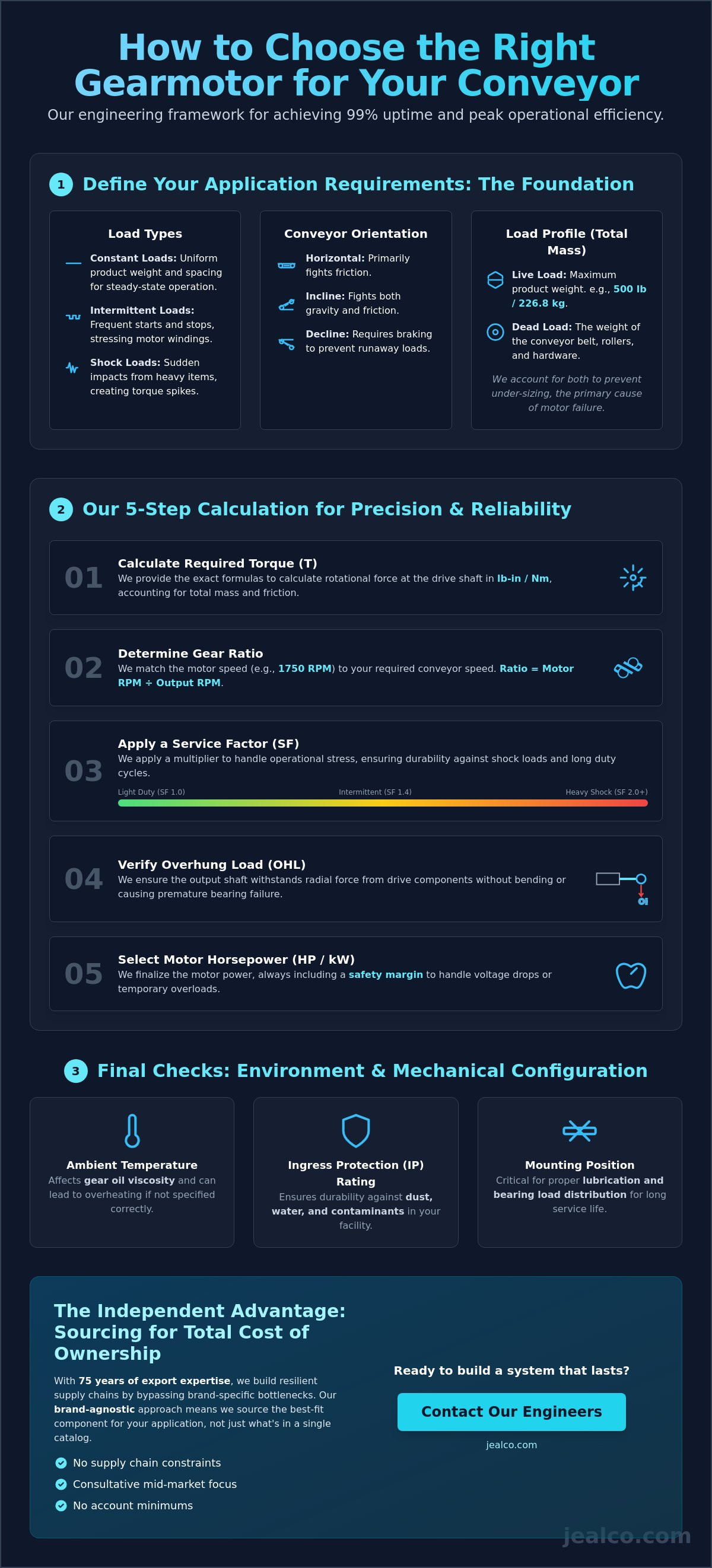
Successful engineering begins with a clear definition of the operational environment. We've seen many projects stall because the load profile was oversimplified during the procurement phase. To understand how to choose a gearmotor for a conveyor application, you must first quantify the forces the motor will fight every second of its service life. We categorize these into three primary types:
-
Constant loads: These feature uniform product weight and spacing, allowing for a steady state of operation.
-
Intermittent loads: These involve frequent starts and stops that stress the motor windings and require higher thermal capacity.
-
Shock loads: These occur when heavy items drop onto the belt, creating sudden torque spikes that can shear gear teeth if the service factor is too low.
The physical orientation of the system dictates the base torque requirement. Horizontal systems primarily fight friction. An incline adds the force of gravity to the equation, necessitating a motor with high starting torque. Conversely, a decline requires a gearmotor with internal braking or self-locking features to prevent a runaway load. We must also define the duty cycle. A motor running 8 hours a day faces different thermal stresses than one operating 24 hours a day in a continuous production environment.
Load Profiles and Mass Calculations
We separate the total mass into two categories: dead load and live load. The dead load includes the weight of the conveyor belt, rollers, and any supporting hardware. The live load is the maximum weight of the product being moved at peak capacity. A 500 lb / 226.8 kg load requires significantly more starting torque than a 100 lb / 45.4 kg load because the motor must overcome the static friction of the entire system before motion begins.
Friction factors vary based on the interface between the belt and the bed. A smooth PVC belt on a steel slider bed has a different coefficient than a modular plastic chain on wear strips. We recommend consulting our technical catalog for heavy duty conveyor belting to find specific material weights and friction data. Ignoring these variables often leads to under-sizing, which is the primary cause of premature motor failure.
Speed and Throughput Targets
Specify your target linear speed in feet per minute (fpm) or meters per second (m/s). This speed depends on the drive roller diameter and the output RPM of your gearing products. A smaller drive roller requires more rotations to achieve the same linear speed as a larger roller, which changes the required gear ratio.
If your process requires varying speeds for different products, we suggest integrating a variable frequency drive (VFD). A VFD allows for soft starts and precise control over the throughput. This prevents the mechanical jarring associated with across-the-line starting and extends the life of the internal gears. In our experience, systems utilizing VFDs show a measurable decrease in mechanical wear over a five year period.
Calculating Torque, Speed, and Gear Ratios
Precision in your mathematical foundation prevents mechanical failure. Once you define your application requirements, we move to the core of the selection process. If you miscalculate torque, your system will either fail to start under load or consume excessive energy. We follow a rigorous five-step process for how to choose a gearmotor for a conveyor application to ensure long-term reliability.
-
Step 1: Calculate the required torque (T) at the drive shaft in lb-in / Nm. This must account for the total mass and friction factors discussed in the previous section.
-
Step 2: Determine the gear ratio. Divide the motor base speed (typically 1750 RPM) by your target drive shaft RPM.
-
Step 3: Apply a service factor. This multiplier adjusts for the severity of your specific operating environment.
-
Step 4: Verify the overhung load (OHL) capacity. Since conveyor drive pulleys are often mounted directly to the output shaft, the shaft must withstand radial force without bending.
-
Step 5: Select a motor horsepower (HP / kW). We always include a safety margin to handle unexpected voltage drops or temporary overloads.
Refining these values is a critical part of choosing a gearmotor for your application. We offer a comprehensive range of gearing products and electric motors to match these calculated specifications exactly. If you need assistance with complex inertia calculations, contact our technical team for a consultative review.
Understanding Starting vs. Running Torque
Conveyors often require 200% more torque to start than to run. This is particularly true for systems that stop while fully loaded. We utilize high-slip motors in high-inertia conveyor start-ups to provide the necessary boost without overheating the windings. Breakaway Torque is the force needed to overcome static friction. Once the system is in motion, the torque requirement drops to a steady-state running level.
The Critical Role of Service Factors
A service factor is a multiplier for gear durability based on shock and runtime. We define a 1.0 service factor for uniform loads running 8 hours a day. However, for heavy shock loads or 24 hour operations, we specify a factor of 1.5 or higher. We strongly warn against under-sizing gearboxes to save on initial procurement costs. In our experience, saving 10% on a smaller unit often leads to a 300% increase in maintenance costs over the life of the system.
Environmental and Mechanical Configuration Factors
We must evaluate the operating environment before finalizing any equipment order. Extreme temperatures directly affect gear oil viscosity. In cold storage applications reaching 0°F / -17.8°C, standard oil thickens, increasing internal friction and potentially preventing a start-up. High-heat environments require synthetic lubricants to prevent thermal breakdown. We also specify Ingress Protection (IP) ratings based on your specific industry. For example, an IP66 rating is standard for washdown food environments, while IP54 may suffice for a dusty warehouse where particulate matter is the primary concern.
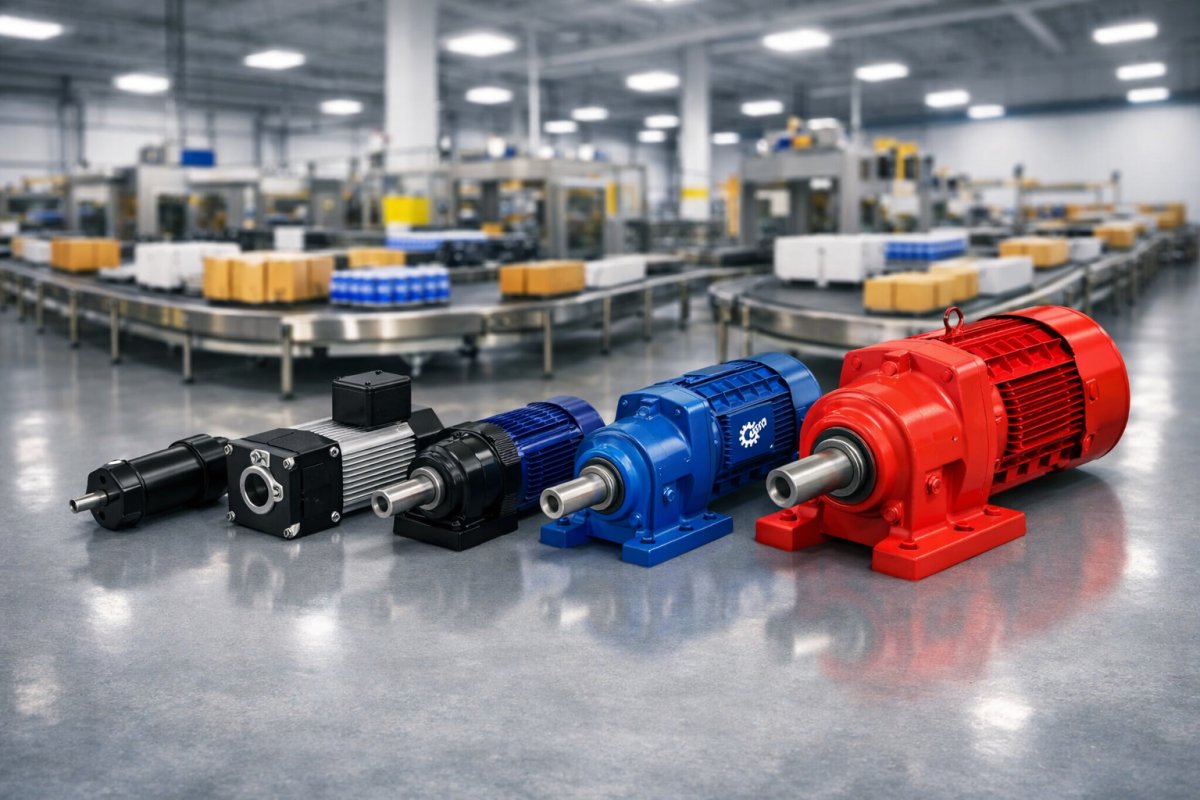
Space on the factory floor often dictates the physical dimensions of the drive unit. We offer right-angle, parallel shaft, and hollow shaft mounting configurations to fit within tight conveyor frames. A hollow shaft design is particularly effective for reducing the overall footprint by eliminating the need for a coupling and a mounting bracket. This mechanical integration is a key step in how to choose a gearmotor for a conveyor application that remains serviceable in cramped quarters. We've found that planning for maintenance access during the initial layout prevents costly downtime during future repairs.
Gearbox Architecture: Worm vs. Helical vs. Cycloidal
We compare efficiency levels across different architectures to ensure your system meets its performance goals. Helical gears typically offer efficiency ratings of 95% or higher, making them the superior choice for high-duty cycle operations. Worm gears are less efficient, often falling between 60% and 80%, but they provide a natural self-locking feature. This is highly beneficial for incline conveyors where you need to prevent back-driving during a power failure. Using right-angle gearing products allows us to mount the motor parallel to the conveyor frame, saving valuable aisle space.
Motor Enclosures and Protection
The choice of enclosure depends on cooling needs and exposure. Totally Enclosed Fan Cooled (TEFC) motors use an external fan to blow air over the frame, while Totally Enclosed Non-Ventilated (TENV) units rely on surface radiation. We recommend TENV motors for washdown areas to eliminate the fan shroud, which can trap bacteria. For food-grade systems, we provide stainless steel housings or specialized epoxy coatings. We issue a specific warning for high-altitude installations above 3,300 ft / 1,000 m. The thinner air reduces cooling efficiency, which requires us to de-rate the motor or select a larger frame size to manage thermal capacity. To accurately select and size gearmotors, we must account for these atmospheric variables early in the design phase.
The Independent Advantage: Sourcing for Total Cost of Ownership
Selecting the right hardware is only half the battle. We believe that how to choose a gearmotor for a conveyor application involves a strategic procurement approach that looks beyond the initial quote. Many manufacturers push their proprietary designs to lock you into their ecosystem. We take a different path. As an independent distributor, we offer consultative sizing without manufacturer bias, ensuring you get the most robust unit for your specific budget and performance requirements.
Total Cost of Ownership (TCO) includes the purchase price, energy costs, and the financial impact of downtime. By selecting high-efficiency electric motors, you reduce long-term operational expenses. We prioritize units with global support networks. This ensures that if a component fails in five years, you won't be stranded by a localized brand that lacks international presence. Our 75 years of export expertise allows us to evaluate these variables across six continents.
Mitigating Lead Times and Supply Chain Risks
In our experience, relying on a single manufacturer often leads to catastrophic downtime during parts shortages. We've seen production lines sit idle for weeks because a specific proprietary gearbox was backordered. We mitigate this risk by sourcing "drop-in" replacements that adhere to standard NEMA or IEC frame dimensions. If one supplier has a 20 week lead time, we use our independence to find a comparable unit with immediate availability. Our logistics team handles the complexities of international shipping to keep your facility running.
Evaluating Component Interchangeability
We encourage engineers to design for maintenance by using standard shaft diameters, such as 1 inch / 25.4 mm. Modular gearmotor designs allow for faster field repairs because you can often replace the motor or the gear head independently. This flexibility is vital when maintaining complex belt conveyors that require high uptime. Standardized components simplify your spare parts inventory and reduce the training required for your maintenance crew.
If you're facing long lead times or need a brand-agnostic technical review of your current system, contact our procurement specialists today for a consultation.
Final Selection Checklist and Procurement Strategy
Validation is the final safeguard against costly engineering errors. Before we issue a purchase order, we cross-reference our calculated torque and RPM requirements against the manufacturer’s specific performance curves. This ensures the unit operates within its most efficient range without exceeding its thermal capacity. We prioritize this step because relying on nominal ratings alone often overlooks the performance drop-off at lower speeds or higher ambient temperatures.
Confirming the mounting orientation is a critical safety and maintenance check. Whether the unit is mounted horizontally or vertically up/down, the lubrication system must be configured to prevent seal failure or dry gear meshing. We also verify the electrical compatibility for the destination country. A motor wound for 460V/60Hz in North America won't perform correctly on a 400V/50Hz grid in Europe or Asia. This level of technical scrutiny is essential when learning how to choose a gearmotor for a conveyor application for global deployment.
A 5-Point Procurement Checklist
-
Item 1: Does the unit meet or exceed the calculated starting torque requirements, especially for loaded restarts?
-
Item 2: Is the gearmotor rated for the specific environmental IP requirements, such as washdown or abrasive dust?
-
Item 3: Are there account minimums or supply chain constraints that could delay the delivery of a single 250 lb / 113.4 kg unit?
-
Item 4: Does the supplier provide dual-unit documentation (imperial and metric) to support international maintenance teams?
-
Item 5: Have we validated the service factor and thermal limits with an independent expert to ensure a 99% uptime target?
Executing the International Order
Moving heavy industrial motors across borders requires precise documentation to ensure seamless customs clearance. We manage the entire logistics chain, providing the necessary certificates of origin and technical data sheets required by international authorities. We focus on providing mid-market flexibility for a single replacement unit or a full system overhaul. This independence allows us to bypass the supply chain bottlenecks that often plague brand-specific distributors.
Our 75 years of export expertise ensures your equipment reaches any of the six continents without administrative delays. If you're ready to finalize your system design, Contact Jealco International for a consultative gearmotor evaluation and ensure your procurement strategy matches your engineering precision.
Optimizing Your Conveyor Drive Strategy for 2026 and Beyond
Mastering how to choose a gearmotor for a conveyor application ensures your facility achieves 99% uptime while meeting the latest IE4 efficiency standards. We prioritize precision in torque calculations and environmental protection to prevent the mechanical failures that stall production. Whether you are moving a 250 lb / 113.4 kg load or designing a high-speed sortation system, the technical foundations we have discussed will protect your long-term investment. By focusing on interchangeable components and brand-agnostic sourcing, we help you build a resilient drive system that remains serviceable for decades.
Our 75 years of export expertise and independent status mean we provide the technical validation you need without the bias of a single manufacturer. We specialize in consultative engineering support for mid-market operations, ensuring every unit matches your specific duty cycle and global voltage requirements. Partner with Jealco for independent, expert gearmotor sourcing and global logistics to streamline your international procurement process across six continents. We look forward to helping you optimize your next conveyor project with robust, reliable solutions.
Frequently Asked Questions
What is the difference between AC and DC gearmotors for conveyors?
AC induction motors are the industry standard for most conveyor applications because they're robust and require minimal maintenance. DC gearmotors excel in specialized applications requiring high torque at very low speeds, though they involve higher maintenance costs due to brush wear. We typically recommend AC units paired with modern controllers for the best balance of reliability and speed control.
How do I calculate the required torque for an inclined belt conveyor?
To calculate torque for an incline, we sum the force required to overcome friction with the force required to lift the mass against gravity. You must multiply the total weight of the product and belt, such as 200 lb / 90.7 kg, by the sine of the incline angle. This value is then multiplied by the drive pulley radius to determine the required torque in lb-in / Nm.
Why is the service factor so important in gearmotor selection?
The service factor acts as a safety multiplier that protects the internal gears from premature fatigue caused by shock loads or continuous operation. We assign a higher factor to systems running 24 hours a day compared to those running 8 hours. Neglecting this value is a primary reason why many fail when learning how to choose a gearmotor for a conveyor application.
Can I use a VFD with any standard conveyor gearmotor?
You can use a Variable Frequency Drive (VFD) with most modern gearmotors, provided the motor is inverter duty rated to handle increased thermal stress at low frequencies. Standard motors often overheat when run at low speeds because their internal fans don't spin fast enough to dissipate heat. We verify the insulation class and speed range of every unit before recommending a VFD integration.
What are the most common causes of gearmotor failure in material handling?
Improper sizing is the leading cause of failure, where the motor lacks the starting torque to move a stalled load. Lubrication leaks and bearing contamination in washdown environments also account for significant downtime in material handling. In our experience, selecting a unit with an inadequate IP rating often leads to internal corrosion within the first year of service.
How does ambient temperature affect the performance of my conveyor drive?
Ambient temperature directly alters the viscosity of the gear oil, which impacts mechanical efficiency and seal life. In cold storage reaching -20°F / -28.9°C, we specify synthetic lubricants to prevent the oil from becoming too thick for the gears to turn. Conversely, high heat requires specialized seals to prevent oil thinning and subsequent leakage.
Is it better to use a right-angle or parallel shaft gearmotor?
Right-angle gearmotors are ideal for tight conveyor layouts because they allow the motor to sit parallel to the frame, saving aisle space. Parallel shaft units generally offer higher mechanical efficiency, often exceeding 95%. We choose between them based on the available footprint and the specific torque requirements of the drive shaft.
What maintenance is required for a sealed-for-life gearmotor?
Sealed-for-life gearmotors don't require periodic oil changes, but they still need regular inspections for seal integrity and shaft vibration. We recommend checking for oil weeping around the output shaft every 2,000 hours of operation. Even without a lubrication schedule, monitoring the operating temperature helps identify bearing wear before it causes a catastrophic failure.