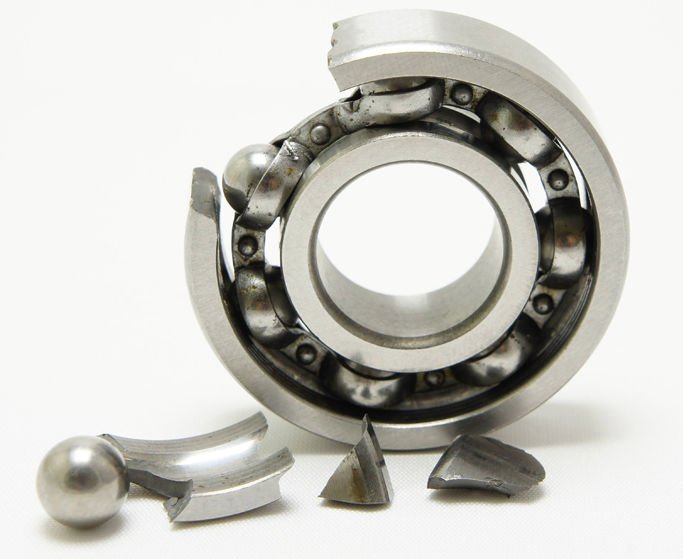
Why are your bearings reaching the end of their service life months before the manufacturer's L10 rating, even when your team follows every grease schedule to the letter? We know the frustration of unplanned downtime that drains thousands of dollars per hour from your production lines. In our experience, the causes of premature industrial bearing failure are rarely linked to inherent material defects. Instead, they often stem from preventable human practices and environmental stressors that occur during procurement, storage, or installation.
Research from 2026 indicates that improper lubrication accounts for up to 40% of early failures, while misalignment can slash a bearing's calculated life by 50%. We'll help you look beyond basic maintenance to identify hidden risks in your logistics and storage environments. You'll learn how to establish a brand-agnostic sourcing strategy that prioritizes technical specifications over manufacturer labels to ensure your components survive the harshest conditions.
This guide breaks down the latest ISO 15243:2017 classification standards for damage like electrical erosion and fatigue. We'll also explore how smart sensors and predictive analytics are transforming how we monitor components operating at high temperatures, such as 250°F / 121°C. By the end, you'll have a clear roadmap to optimize your MRO procurement and significantly extend your equipment's operational cycle.
Key Takeaways
- Identify the primary causes of premature industrial bearing failure, focusing on how to maintain the essential oil film that separates rolling elements.
- Learn to detect invisible threats like 2-micron particulate matter and moisture ingress that lead to etching and static vibration corrosion in wash-down environments.
- Master precision installation techniques to prevent misalignment of 0.001 inch / 0.025 mm per inch, which can slash your bearing life by 20% or more.
- Discover why storage conditions matter for long-term reliability, specifically how horizontal storage for over 12 months causes grease slump and localized oxidation.
- Implement a brand-agnostic sourcing strategy that prioritizes Total Cost of Ownership (TCO) and predictive maintenance over the lowest initial bid.
Solving the Lubrication Crisis: Why Most Bearings Fail Before Their Time
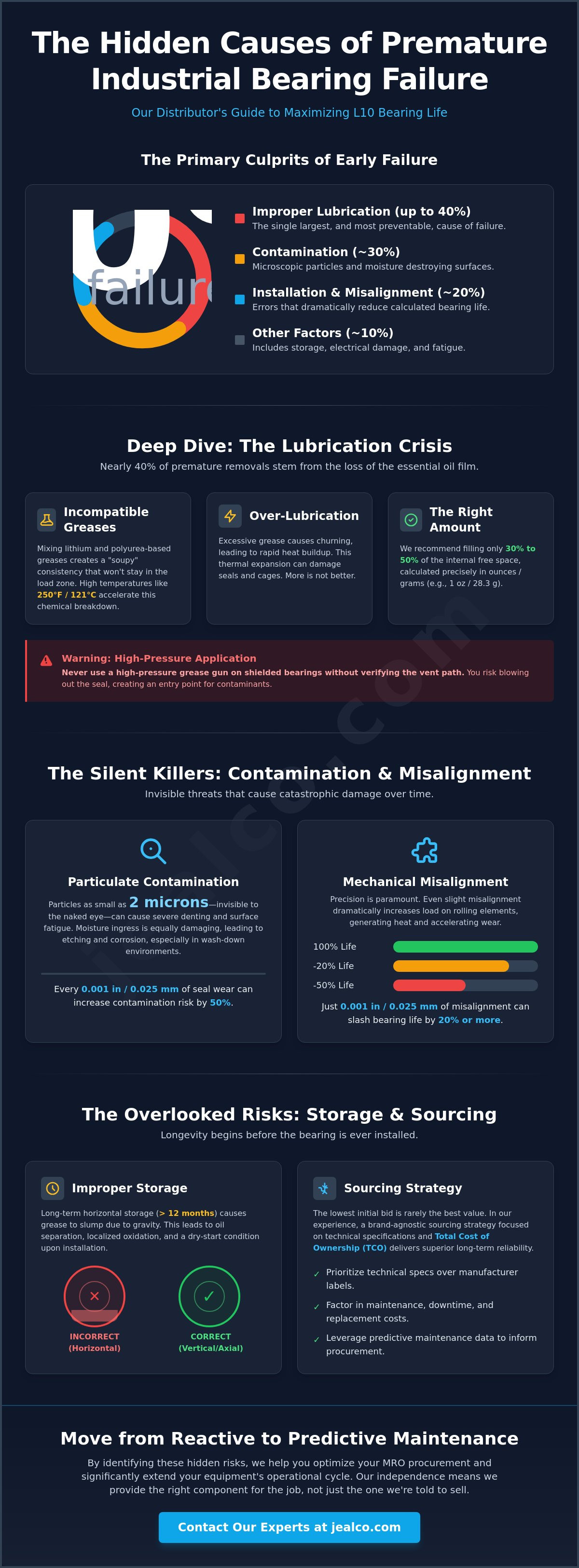
Lubrication failure is the single most common contributor to industrial downtime. It accounts for nearly 40% of all premature bearing removals. We don't define this failure simply as a bearing "running dry." It is the loss of the essential oil film that separates rolling elements from the raceways. Without this microscopic barrier, the causes of premature industrial bearing failure begin to manifest as surface distress and eventual fatigue.
In our experience, using the wrong base oil viscosity for a specific load leads to metal-to-metal contact within hours. This contact generates intense localized heat. We provide a technical framework for calculating the required film thickness based on operating temperature and rotational speed (RPM). Our independence from brand-specific agreements allows us to recommend the ideal lubricant chemistry for your environment without bias. Ensuring this film stays intact is vital for any Rolling-element bearing to reach its rated L10 life. You can find technical specifications for various components in our online catalog.
Viscosity and Chemical Compatibility
Mixing incompatible greases is a frequent error in multi-brand facilities. Combining lithium-based and polyurea-based greases creates a "soupy" consistency. This mixture loses its ability to stay in the load zone and fails to protect the races. High operating temperatures, such as 250°F / 121°C, accelerate this degradation. Heat causes lubricant oxidation and forces the oil to separate from the thickener.
We select lubricants based on the DN factor of the application. This is the product of the bearing's pitch diameter and the RPM. High DN factors require lower viscosity oils to reduce fluid friction. Conversely, slow, heavy loads need high-viscosity lubricants to maintain that essential film. Getting this balance right is the first step in preventing the causes of premature industrial bearing failure.
The Dangers of Over-Lubrication
Many technicians believe that more grease is always better. This is a costly misconception. Excessive grease causes a phenomenon called churning. The rolling elements must push through too much material, which leads to rapid heat buildup. This thermal expansion can cause seal rupture or cage failure.
We recommend calculating grease volume precisely in ounces / grams (e.g., 1 oz / 28.3 g) based on the bearing's physical dimensions. A common rule of thumb is to fill only 30% to 50% of the internal free space. Warning: Never use a high-pressure grease gun on shielded bearings without verifying the vent path. High pressure can easily blow out a seal, allowing contaminants to enter the raceway.
Contamination and Corrosion: The Silent Killers of Industrial Assets
Particulate matter as small as 2 microns can destroy a bearing raceway. These particles are invisible to the naked eye, yet they cause severe denting and surface-initiated fatigue. In our experience, these microscopic contaminants are among the most frequent causes of premature industrial bearing failure in bulk handling facilities. Moisture ingress is equally dangerous. It leads to etching and "static vibration" corrosion. This is particularly prevalent in wash-down environments where high-pressure cleaning forces water past inadequate seals, compromising the lubricant's integrity.
We often analyze the effectiveness of contact seals versus labyrinth seals for belt conveyors operating in high-debris areas. While contact seals provide a physical barrier, they are prone to friction and wear. Every 0.001 inch / 0.025 mm of seal wear increases the risk of lubricant contamination by 50%. Labyrinth seals offer a non-contact, frictionless alternative, but they require precise orientation to prevent moisture ingress. You can find detailed specifications for various sealing arrangements in our online catalog.
Sealing Solutions for Harsh Environments
Choosing the right material is critical for long-term reliability. We use NBR (Nitrile) for standard applications, but we recommend Viton for environments requiring high chemical resistance or temperature stability. For vertical shaft applications, flinger rings act as a primary defense by using centrifugal force to repel liquid ingress. We also monitor for "False Brinelling." This occurs when external vibrations create depressions in the raceway while the bearing is stationary. This is common during long-distance shipping or when standby equipment sits near active machinery.
Corrosion Prevention Strategies
Stainless steel bearings are not a universal solution. They often lack the load capacity of high-carbon chrome steel. We suggest specialized coatings like thin dense chrome or black oxide for many MRO sourcing needs. These coatings provide excellent corrosion resistance without compromising the mechanical integrity of the component. We also advise implementing a "clean room" protocol for every installation on the factory floor. This involves using dedicated tools and keeping components in their original packaging until the moment of mounting. If you need help specifying a sealing arrangement for a specific environment, our technical team can review your application data.
Eliminating Installation Errors and Mechanical Misalignment
Precision begins the moment a bearing meets the shaft. Many maintenance teams treat bearing installation as a brute-force task, but even minor errors during mounting stand as leading causes of premature industrial bearing failure. Misalignment of just 0.001 inch / 0.025 mm per inch of shaft length can slash the bearing's service life by 20% or more. We see these failures often in high-torque applications where the initial setup didn't account for the extreme mechanical stresses of a full production cycle.
Improper fitment is another critical risk. If a bearing is too loose on the shaft, it will spin, causing fretting and heat. If it's too tight, it reduces the internal clearance required for the component to function. This clearance, typically designated as C3 or C4, is vital for allowing the rolling elements to move freely as temperatures rise. Never use a hammer directly on a bearing ring; the resulting micro-cracks are a death sentence for the component. These cracks are often invisible to the naked eye but will lead to catastrophic spalling under load.
Precision Fitment and Clearance
We emphasize the importance of choosing between interference fits and slip fits based on whether the load is rotating or stationary. In our experience, using induction heating for high-precision fits is far superior to cold mounting with a press. Thermal expansion at 150°F / 65°C can seize a bearing if the initial internal clearance was insufficient. We recommend using induction heaters and hydraulic nuts to ensure safe, repeatable installation that maintains the integrity of the raceways. You can find specialized tools and components for these setups in our online catalog.
Correcting Shaft and Housing Misalignment
Shafts must be parallel within 0.002 inches / 0.05 mm to avoid uneven loading. We use laser alignment tools to verify these tolerances across the entire drive train. A frequent but overlooked issue is "soft foot," where the bearing housing doesn't sit perfectly flat on its base. This creates internal stress and increases vibration levels. While we advocate for perfect alignment, high-quality shaft couplings are critical for absorbing minor, unavoidable misalignments. These components act as a fuse, protecting your expensive bearings from the causes of premature industrial bearing failure linked to structural shifts or thermal growth.
The Distributor's Perspective: How Sourcing and Storage Impact Longevity
Many operations managers assume a bearing's lifespan begins at installation. In reality, the clock starts the moment the component leaves the factory floor. Poor logistics and improper storage are frequently overlooked causes of premature industrial bearing failure. We ensure that every component we ship across six continents arrives with its metallurgical and chemical integrity intact.
In our experience, bearings stored horizontally for over 12 months can suffer from "grease slump." This occurs when the oil separates from the thickener and pools at the bottom of the bearing. This localized oxidation creates a dry spot that will fail almost immediately upon startup. We also protect our shipments from "tramp" vibrations and salt air during international transit to prevent these hidden causes of premature industrial bearing failure.
Our independence allows us to source the best-fit component for your specific application. We don't push a single brand's inventory just to meet a manufacturer's sales quota. This flexibility is vital when navigating global supply chain constraints or seeking specialized performance. We focus on technical specifications and performance data to solve your reliability challenges rather than brand loyalty.
Optimizing Bearing Storage and Shelf Life
We recommend maintaining a temperature-controlled environment of 68°F / 20°C for all MRO spares. This stability prevents lubricant degradation and keeps condensation from forming inside the packaging. Bearings should always be stored flat in their original, unopened boxes to prevent moisture absorption. We advocate for a strict First-In, First-Out (FIFO) inventory system to ensure no component exceeds its recommended shelf life.
The Value of Independent Distribution
Our mid-market focus allows us to provide consultative sourcing without the burden of account minimums. We help you identify high-quality alternative brands like Frantz when lead times for major manufacturers become unmanageable. Verifying the Country of Origin and the Date of Manufacture is a standard part of our quality control process for every order. If you need assistance auditing your current inventory or sourcing hard-to-find components for your gearing products, contact our procurement specialists today.
Strategic Prevention: Designing for Maximum L10 Life
True cost savings in any industrial facility come from the Total Cost of Ownership (TCO) rather than the initial purchase price. We often see procurement teams prioritize the lowest bid, only to face catastrophic expenses when those components fail prematurely. One of the most avoidable causes of premature industrial bearing failure is the selection of an incorrect bearing type for the specific load profile. Choosing between ball, roller, or tapered bearings requires a precise analysis of the ratio between radial and axial loads.
A mismatch in this area leads to uneven stress distribution and rapid fatigue. For instance, using a standard deep-groove ball bearing in an application with high axial thrust will cause cage failure and raceway spalling within weeks. We advocate for consulting with an independent expert during the initial design phase of belt conveyors and other heavy machinery. This proactive approach prevents the need for expensive retrofits and ensures the selected components can handle the actual operational stresses of your facility.
Predictive Maintenance and Condition Monitoring
We recommend integrating vibration analysis and thermography into your predictive maintenance schedule to catch issues before they stop production. Ultrasound is particularly effective for detecting early-stage lubrication failure. It identifies the sound of metal-to-metal contact before the bearing generates enough heat to be detected by traditional sensors. We suggest setting vibration thresholds at specific levels, such as 0.15 ips / 3.8 mm/s, to provide early warning signs of raceway degradation.
Automated lubrication systems are another vital tool for strategic prevention. These systems eliminate human error and ensure consistent delivery of grease to remote pulleys and rollers where manual access is difficult or dangerous. By maintaining a constant, precise volume of lubricant, you protect the internal clearances of the bearing and significantly extend its service life.
A Procurement Checklist for Bearing Longevity
To ensure you are sourcing the most robust components for your application, we suggest following a technical procurement checklist. This process moves beyond brand names and focuses on the engineering data that dictates performance in the field. Our independence from manufacturer constraints allows us to help you verify these specifications across multiple high-quality brands.
- Verify Load Ratings: Confirm the Dynamic Load Rating (Cr) and Static Load Rating (Cor) in lbf / kN (e.g., 10,000 lbf / 44.5 kN) against your peak operational requirements.
- Confirm Seal Compatibility: Ensure the seal material can withstand local environmental contaminants, such as abrasive dust, caustic chemicals, or high-pressure water.
- Audit Origin and Date: Check the "Country of Origin" and the "Date of Manufacture" to guarantee the metallurgical quality and lubricant freshness of the batch.
As a final step, we recommend contacting Jealco for a brand-agnostic review of your high-failure applications. Our technical team will analyze your failure modes and help you implement a sourcing strategy that maximizes your equipment's operational cycle.
Optimizing the Operational Lifecycle of Your Industrial Assets
Eliminating unplanned downtime requires a shift from reactive repairs to a technical understanding of the component lifecycle. We've shown that operational success depends on maintaining a precise oil film and preventing 2-micron contaminants from entering the raceways. Precision installation and climate-controlled storage are not optional; they are the foundations of long-term reliability.
By addressing the primary causes of premature industrial bearing failure, you protect your facility from costs that often exceed thousands of dollars per hour in lost production. We leverage our independence to provide the exact technical specifications your application requires. We don't answer to manufacturer quotas, which means our advice focuses solely on your equipment's performance and durability.
Our team brings 75 years of export expertise and a global logistics reach across six continents to your MRO strategy. We provide the consultative support needed to ensure your components reach their full L10 design life in any environment. Contact Jealco International for expert bearing sourcing and technical support to optimize your supply chain today. We're ready to help you build a more robust and profitable operation.
Frequently Asked Questions
What are the first signs of industrial bearing failure?
Increased audible noise and elevated operating temperatures are the most reliable early indicators. We monitor for temperature spikes exceeding 180°F / 82°C; this often signals a breakdown in the lubricant's oil film. Ultrasonic sensors can detect these changes weeks before they become audible to the human ear. Vibration typically appears as a late-stage symptom once significant raceway damage has already occurred.
How often should I lubricate my industrial bearings?
Lubrication intervals depend on the bearing's rotational speed, load, and ambient environment rather than a fixed calendar. We calculate these intervals using the DN factor (bore diameter x RPM) and specific load ratings. High-speed applications may require weekly relubrication; while slow, heavily loaded components might only need attention every six months. We help our clients establish these schedules to prevent the causes of premature industrial bearing failure related to over or under-lubrication.
Can I reuse a bearing that was removed for inspection?
We don't recommend reusing bearings that have been pulled from an interference fit. The force required to remove a bearing often causes invisible damage to the raceways or seals. Even minor mounting errors during the second installation can compromise the internal clearance. Unless the component is part of a certified remanufacturing program, the risk of early failure far outweighs the cost of a new replacement.
What is the difference between C3 and C4 bearing clearance?
These designations refer to the internal radial clearance between the rolling elements and the raceways. C3 clearance is greater than the "Normal" standard; C4 is greater than C3. We specify C4 bearings for applications with high thermal gradients where the inner ring expands significantly. Using a C3 bearing when a C4 is required can lead to internal preload and rapid heat buildup.
How do I calculate the L10 life of a bearing in my application?
L10 life represents the basic rating life that 90% of a group of identical bearings will reach or exceed. We use the formula L10 = (C/P)^p, where C is the basic dynamic load rating and P is the equivalent dynamic load. For ball bearings, the factor "p" is 3; for roller bearings, it's 10/3. This calculation provides a baseline for identifying the causes of premature industrial bearing failure when actual service life falls short.
Why do bearings fail shortly after a wash-down cycle?
High-pressure water at 1,000 psi / 68.9 bar can easily bypass standard seals and displace the grease inside the housing. As the bearing cools after operation, it creates a vacuum that pulls moisture and cleaning chemicals directly into the raceways. This leads to etching and rapid corrosion. We recommend using specialized wash-down housings and labyrinth seals to protect components in food processing or chemical environments.
Does shaft misalignment always cause vibration?
Misalignment doesn't always produce immediate, high-amplitude vibration that is detectable without precision tools. It can manifest as a steady increase in operating temperature due to the uneven load distribution across the rolling elements. In our experience, this "silent" stress fatigues the cage and raceways long before the machine begins to shake. We use laser alignment to ensure shafts stay within 0.002 inches / 0.05 mm of parallel.
What are the benefits of using a ceramic hybrid bearing?
Ceramic hybrid bearings use silicon nitride balls which are lighter and harder than traditional steel. These components provide excellent electrical insulation; this prevents the electrical erosion often seen in motors controlled by Variable Frequency Drives (VFDs). They also operate at lower temperatures and higher speeds due to reduced centrifugal force. We source these for high-precision applications where standard steel components fail due to electrical stray currents.